
GERNIKASacred City of the Basque People
A story of ancient roots, devastating fire, and the enduring spirit of a people who refused to be erased
Where the Land Remembers
Gernika sits in the green hills of Bizkaia, in the heart of the Basque Country — one of Europe’s oldest inhabited regions, home to a people whose origins remain one of history’s great mysteries.
The Basques, known in their own tongue as Euskaldunak (speakers of Euskara), are linguistically and genetically distinct from all neighboring peoples. Their language, Euskara, has no known ancestor — a living fossil from before the Indo-European wave washed over Europe some four thousand years ago. Gernika emerged from this ancient world as a market town in the medieval period, its first recorded charter dating to 1366.
Yet its significance far predated any document. The area had long been considered sacred ground, a gathering place where the clans of Bizkaia came to deliberate, resolve disputes, and affirm collective life under the shade of a great oak tree — the Gernikako Arbola, the Tree of Gernika.
The Tree of Gernika
Gernikako Arbola
For centuries, the Lords of Bizkaia — and later the Spanish monarchs as rulers of Bizkaia — were required to travel to Gernika and swear an oath beneath this oak to uphold the ancient laws and liberties of the Basque people, known as the Foru or Fueros. But the ritual was never the oak alone. Before processing to the tree, kings and lords first heard Mass at the Church of Santa María la Antigua, whose origins trace to a small chapel that once stood within an ancient oak grove — the very same grove from which the solitary sacred tree descended. The oath-taking was thus a two-part sacred act: a spiritual preparation within the church, followed by a civic covenant beneath the sky. The sacred and the constitutional were inseparable.
The Juntas Generales de Bizkaia, the parliament of Bizkaia, met here. The oak became the supreme symbol of Basque autonomy and democratic tradition — a living covenant between rulers and the governed. By the early 17th century, Gernika had also acquired a Franciscan presence — a convent established in 1610, later expanded to include a church and school. The Franciscans were not architects of the Fueros, but they wove themselves into the everyday religious and intellectual life of a town that already bore an ancient constitutional identity. Theirs was the pastoral complement to the oak’s civic grandeur.
When the original tree died, its descendant was planted beside it. The current tree, the fifth in an unbroken lineage, continues to grow today. Basque poet José María Iparraguirre immortalized it in Gernikako Arbola (1853), which became the unofficial Basque anthem — perhaps the world’s only national song in praise of a tree.
“Gernikako arbola / Da bedeinkatua / Euskaldunen artean / Guztiz maitatua.”
The Tree of Gernika / Is blessed / Among the Basques / Greatly beloved.
A Town at the Heart of Liberty
The Sky Falls.
The Town Burns.
It was a Monday — market day. The streets and squares of Gernika were filled with farmers, merchants, and refugees fleeing the front lines. Then, at 4:30 in the afternoon, the bombers came.
For over three hours, waves of Heinkel He 111s, Junkers Ju 52s, and Messerschmitt fighters bombed and strafed the town. High-explosive bombs shattered buildings; incendiary bombs followed to set the rubble alight. Fighter planes flew low to machine-gun civilians attempting to flee into open fields.
The bombing was not a military assault on a strategic target. It was an experiment — a test of what aerial bombardment could do to a civilian population, and a calculated strike at the spiritual heart of Basque resistance. The Casa de Juntas (parliament house) and the sacred oak, just outside town, were deliberately spared — a grotesque statement that this was annihilation of a people, not just a place.
The fires burned for three days. When they were extinguished, approximately 70% of the town lay in ruins. Gernika became the first major city in modern history to be destroyed by aerial bombardment — and a warning to the world of what was coming.
Among the journalists who rushed to the ruins that night was George Steer, 28-year-old correspondent for The Times of London. Unlike others who filed immediately, Steer stayed behind in the burning town talking to survivors, collecting fragments of incendiary bombs stamped with the German eagle, and returned at dawn to see the destruction in daylight. In his despatch — published two days later in both The Times and The New York Times — he noted that the sacred oak and the Church of Santa María had been left standing amid the ruins. The world read his words and understood what they meant.
Note: Casualty figures were long disputed by Franco’s regime, which initially denied the bombing occurred at all — claiming Basque forces had destroyed the town themselves. The lie persisted for decades.
Guernica — When Art Becomes Memory
Pablo Picasso learned of the bombing while in Paris — not from a Basque source, but from a newspaper. He was Andalusian, not Basque, with no ancestral connection to Gernika. That an outsider became the bombing’s most enduring witness is itself part of the story.
The chain of witness ran like this: survivors spoke to journalists in the burning streets; George Steer of The Times gathered their testimonies, collected fragments of German bomb casings as evidence, and filed a despatch of extraordinary precision and moral clarity. It ran in The Times and The New York Times on April 28, 1937 — two days after the bombing. In Paris, Picasso read it. Within days, his friend the poet Juan Larrea visited his studio and urged him to make the bombing his subject. On May 1st, Picasso abandoned his original commission and began work on what would become Guernica. A survivor’s word, carried by a journalist’s pen, ignited a painter’s brush.
Steer’s own report had noted, amid the devastation, that the sacred oak and the Church of Santa María la Antigua had survived the bombardment — the same church where kings had heard Mass before swearing their oaths beneath the tree. The bombers had spared them deliberately, making the obliteration of the surrounding town all the more savage in its symbolism. Steer saw this. He wrote it. The world read it. And Picasso painted it.
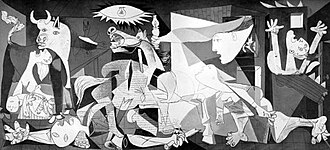
The tile mosaic reproduction of Guernica — photographed in Gernika

The ceramic tile mosaic of Guernica in the town of Gernika itself, inscribed “Guernica Gernikara” — Guernica belongs to Gernika. The original oil on canvas (349 × 776 cm) hangs in the Museo Reina Sofía, Madrid.
View the original at Reina Sofía ↗Picasso’s Guernica — painted in stark black, white, and grey — depicts screaming figures, a dying horse, a wounded bull, a dismembered soldier, and a mother clutching her dead child. It makes no concession to beauty or narrative resolution. It is pure anguish, fractured and timeless. Picasso was Andalusian, not Basque — his championship of Gernika was an act of solidarity across regional lines, a declaration that this atrocity belonged to all humanity’s conscience.
The painting traveled the world as an ambassador of anti-Fascist sentiment. Picasso refused to allow it to return to Spain until democracy was restored. It lived in New York’s Museum of Modern Art for decades, finally coming home to Madrid in 1981, six years after Franco’s death.
Today, Guernica hangs in the Museo Reina Sofía in Madrid. A tapestry reproduction hangs outside the UN Security Council chamber — the room where decisions of war and peace are made — though it has been covered with a blue curtain on multiple occasions when officials have announced military actions. As for George Steer, Gernika honoured him in 2006 by unveiling a bronze bust and naming a street in his memory — a journalist given a place among the town’s permanent dead.
Decades of Silence
After Franco’s victory in 1939, the Basque language was banned. Speaking Euskara in public could result in fines or arrest. Basque names were forbidden. Cultural expressions of Basque identity were criminalized.
Gernika was rebuilt — partly as a Franco-era propaganda exercise, with the regime claiming it had been the Basques themselves who burned the town. Official Spain denied for decades what the world had witnessed. The Condor Legion’s own records, the testimony of foreign journalists who had been present, and the word of survivors were all dismissed.
Yet Basque culture survived in kitchens, in whispered songs, in the mountains where bertsolariak (Basque oral poets) kept the language alive, and in the diaspora communities of South America and the American West. The oak tree — survivor of the bombing — became a quiet, powerful act of defiance simply by continuing to grow.
It was not until the dying years of the Franco dictatorship and the Spanish Transition to Democracy that the full truth of Gernika was publicly acknowledged within Spain.
Rebuilding the Sacred City
With Spain’s return to democracy in the late 1970s, the Basque Country won its statute of autonomy (1979), Euskara was co-officialized alongside Spanish, and Gernika could finally begin to reckon openly with its history. Today the city is a living monument to both the horror of what happened and the tenacity of those who survived.
The Living Oak
The current oak, descended through generations from the original, still grows in the grounds of the Casa de Juntas. The stump of its 300-year-old predecessor stands beside it.
Casa de Juntas
Gernika’s parliament house still functions. The Juntas Generales of Bizkaia meet here, and the institution remains a living emblem of Basque self-governance.
Peace Museum
The Gernika Peace Museum tells the story of the bombing and its aftermath, and explores the wider themes of peace, reconciliation, and the rights of civilian populations in war.
Guernica Returns
Though the painting lives in Madrid, a large reproduction mosaic by Eduardo Paolozzi adorns Gernika’s streets, and the town’s connection to Picasso’s masterwork is proudly commemorated.
Basque Parliament
The Basque Autonomous Community was established in 1979, restoring the Fueros spirit. Gernika retains its symbolic status as the seat of Basque democratic legitimacy.
Euskara Lives
The Basque language is now taught in schools, used in government, and spoken by a growing number of young Basques — a language that outlived every empire that tried to erase it.
What Gernika Means
Gernika is three things at once: a real town of some 16,000 people in the hills of Bizkaia, a sacred symbol of a people’s will to self-determination, and a universal name for the crime of targeting civilians from the air.
In the Spanish language and in international political discourse, una Guernica has come to mean any act of mass civilian slaughter. The name has been borrowed for conflicts from Chechnya to Syria, from Iraq to Yemen. Gernika’s tragedy echoes wherever air power is turned against unarmed populations — which is to say, it has echoed ceaselessly since 1937.
But there is another side to Gernika’s legacy: survival. The oak still grows. The Juntas still meet. Children learn Euskara in schools. The market still comes to town on Mondays — as it did on the day the bombs fell, as it has for centuries. Gernika teaches not only the depths of human cruelty, but the tenacity of culture, memory, and identity in the face of annihilation.
The town’s motto, adapted from the bombing’s bitter truth, might as well be: they tried to bury us. They did not know we were seeds.
The Tree of Gernika is blessed. — José María Iparraguirre, 1853