
Gospel Fermentation in Basque Country — A Three-Part Series – Part 2 of 3
Every movement in history has been forged under pressure, not protected from it. The early Christians didn’t develop their theology of lordship in a seminar room — they hammered it out under Caesar’s shadow, where the confession Jesus is Lord was not religious decoration but an act of spiritual defiance that reorganized everything. That same pressure is what separates inherited belief from movement DNA. And if we’re serious about gospel fermentation in a place like Basque Country — a culture thick with its own history of ultimate loyalties, ideological exhaustion, and deep institutional suspicion — we have to begin here: with what it actually means to live under the lordship of Jesus, and what happens when that conviction becomes non-negotiable, reproducible, and small enough to fit in a living room.
What We Mean by Movement
When people use the word movement, they usually mean one of three things.
The first is a successful ministry — a growing gathering, a strong brand, great teaching, a congregation that is healthy and expanding. This is genuinely good. But it is not a movement.
The second is a missional network — multiple teams and organizations embedded across a city, coordinated and collaborative, working toward shared goals. This too is good, and more complex. But it is still not quite a movement.
The third is a reproducing discipleship movement — disciples making disciples, communities birthing communities, leadership emerging from within the harvest itself. This is the one that behaves differently from the others. It spreads like a wildfire that jumps firebreaks because it is fueled from within, not sustained by outside input.
The question that sharpens everything is this: are we after influence, or are we after gospel fermentation?
Jesus described the Kingdom of Heaven as yeast that a woman hid in a large amount of flour until the whole batch was leavened. Fermentation is not a broadcast. It is not a platform or a program or a gathering. It is biological, relational, and internal — yeast works from within the dough, not on top of it. It multiplies rather than merely grows. It crosses barriers naturally, the way yeast moves through flour. And it is largely invisible until it has already worked deeply.
That is the image that governs everything that follows. Not a church planted on a hill. Yeast hidden in dough.
Lordship as the Furnace
The early Christians lived under the shadow of Caesar. The underground church in China lived under an atheistic regime. In both, the confession Jesus is Lord wasn’t religious decoration — it was spiritual defiance and deep freedom simultaneously. It named an allegiance that made everything else fall into place, and made some things impossible.
That kind of clarity is not produced by comfort. It is produced by pressure. The furnace is where movement DNA is forged.
In Basque Country, the pressure is different but real. The competing lordships are subtler than Caesar, but no less demanding.
There is the lordship of Euskal Herria — the Nation as the thing worth dying for, the source of meaning and belonging, the identity that asks for ultimate loyalty and has received it at tremendous cost. There is the lordship of secularist freedom — the post-Franco, post-clerical Basque who has worked hard to be free of any external authority claiming lordship over conscience, and who guards that freedom carefully. And there is the exhausted pragmatism of a culture that has been through ideology, violence, and disillusionment, and now simply wants to live well and be left alone.
Into this, the confession Jesus is Lord is not primarily a threat. It is an answer to a longing.
Basques know what it costs to give ultimate loyalty to something. ETA asked for it. The Church asked for it. The Nation asked for it. Many gave it and were burned. When someone who has lived through that furnace encounters a community where Jesus’ lordship produces genuine freedom, genuine belonging, and genuine hope — not coercion, not nationalism, not performance — that is spiritually defiant in the best possible way. It says: there is a loyalty that does not destroy you.
But here is the implication that cannot be avoided: if the mission team itself has not been through that furnace, it cannot invite Basques into it. The diagnostic question that every missionary, every church planter, every disciple-maker in Basque Country needs to sit with is this:
Where would your life genuinely look different if Jesus’ lordship became non-negotiable in the next 12 months?
Not adjusted. Not incrementally prioritized. Non-negotiable.
That is not a rhetorical question. It is the furnace. And movement DNA is forged there, or it is not forged at all.
mDNA — The Genetic Code You Cultivate
A movement is not a program you implement. It is a genetic code you carry and transmit.
This distinction matters more than it might seem. Programs can be copied without life. Strategies can be adopted without transformation. Methods can be imported and applied with no corresponding change in the people applying them. This is largely what has happened with much of the evangelical missionary effort in post-Christian Europe — the methods arrived, but the life did not travel with them, and the dough remained unleavened.
Movement DNA — mDNA — is the set of elements that, when present together, generate multiplication. It is not any one element in isolation, but the whole ecology of them held together and reinforcing one another.
In Basque Country, that ecology needs to include at least these realities:
Jesus-centered, not organization-centered. The attractor and authority has to be Jesus himself, not a ministry brand, a charismatic leader, or a sending organization. The moment the movement becomes about anything other than Jesus, it loses the one thing that makes it transferable across the cultural barriers that matter. And this is not a small risk — it is worth asking honestly: what are we multiplying? If we get Jesus wrong, whatever we multiply after that could be toxic.
Apostolic confidence. Not aggression, not cultural imperialism — but the quiet certainty that the Gospel is genuinely good news for Basques, not despite their culture but into it. That it has something to say to the longing that nationalism could not satisfy and that secularism has left unfilled.
Missional-incarnational posture. Teams embedded in neighborhoods, in cuadrillas, in txokos — not gathered apart from the city in a Christian subculture, but present in the actual texture of Basque daily life. The yeast is in the dough, not in a separate bowl. This is not primarily a strategy. It is a theology. The Word became flesh and moved into the neighborhood, unnoticed at first. Incarnational mission means entering a space with humility, eyes open to how God is already at work, asking what is God doing here? and then joining in.
Disciple-making at the core. Every gathering, every relationship, every community oriented not just toward content or belonging but toward formation — toward people becoming more genuinely like Jesus and more genuinely capable of helping others do the same.
Reproducible by design. Nothing practiced that a new Basque believer could not pick up and carry within months. If it requires a seminary degree, a professional pastor, or an outside budget to sustain, it will not reproduce. The test of every practice is simple: could someone who came to faith last year do this with their cuadrilla?
When these elements are present together, they generate movement. When one is missing, the ecology tilts. You get community without mission, or mission without formation, or activity without reproduction — all of which can feel like progress while the dough remains flat.
The Fractal Logic — Start Smaller Than You Think
Here is a crucial piece of movement intelligence that is easy to miss: the smallest unit carries the pattern of the whole.
That is how DNA works. Every cell in an organism carries the complete genetic code — not a fragment of it, not a simplified version, but the whole thing. And that is how movements work. The small band carries the pattern of the city movement, or the city movement never actually starts.
This means the first win is not reach the city. The first win is a small band living the Jesus way so genuinely that it can reproduce. And the test is simple: if you cannot reproduce it in a living room, you cannot reproduce it across a city.
So what is the smallest reproducible unit? It is usually something like two or three people who are genuinely following Jesus together — not just holding similar beliefs, but practicing a shared life of obedience, prayer, and Scripture that is visibly changing them. Oriented outward toward specific people — each person carrying a handful of real relationships with Basques not yet following Jesus. Practicing the one-anothers — the relational texture of the Kingdom visible in how they treat each other. Able to tell the story — each person capable of narrating what Jesus has done and is doing in their own life, in Euskara or Castilian, in the language of the people they are with. And apprenticing someone — at least one relationship in which formation is intentionally happening, where someone is being invited further into the Jesus way.
That is the cell. That is the yeast particle. Not a church, not a program, not even a formal gathering. Two or three people living this way, who can invite one more person into it, who then becomes someone who invites one more.
Now here is where the Basque context becomes not an obstacle but an extraordinary gift.
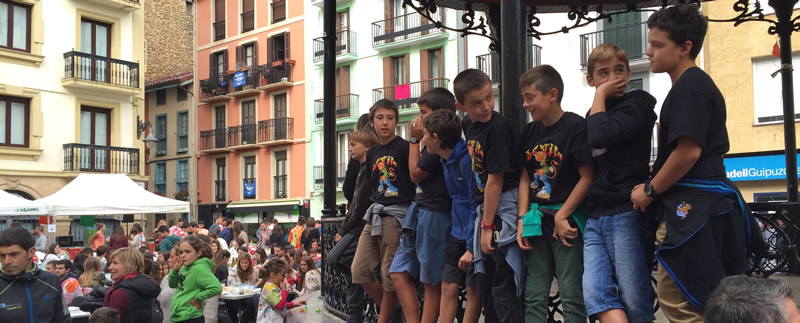
The cuadrilla — the tight friend-group that forms in adolescence and often lasts a lifetime — is already a band of people with deep loyalty to each other, oriented around shared life rather than shared ideology, and a natural transmission network for anything that proves genuine. Basques do not need to be taught community. They are already living in one of the most coherent forms of it in the Western world.
The question is not how do we build community? The question is this:
What happens when one or two people within a cuadrilla begin to genuinely follow Jesus?
If the mDNA is present in them — if their discipleship is real, reproducible, and oriented outward — the cuadrilla becomes the dough. And they become the yeast. The long pintxos evening, the txoko meal, the friendships that have lasted twenty years — these are not obstacles to navigate around. They are the very medium through which fermentation travels.
That is where the city movement begins. Not in a church plant. In a cuadrilla where someone’s life has changed and they cannot stop talking about why.
In the next post, we’ll look at what happens when that fermentation is happening in multiple places simultaneously — and why movement can thrive even when organizations are working separately, with little formal collaboration.