
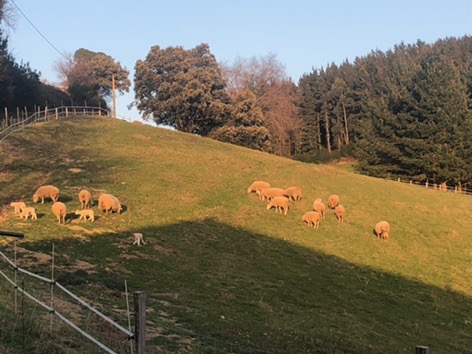
Six Practical Lessons on Encountering the Good Shepherd
ez zait ezer faltako.”
— Salmoa 23:1
A series for the herria — the people of the Basque land
The Basque people carry one of the oldest living identities in Europe. The Euskara tongue predates the Indo-European migrations. The baserri — the mountain farmstead — is the sacred center of Basque memory. The artzaina who spends months in the Pyrenees with his flock, knowing each animal by name, reading cloud and wind and stone, is not a biblical metaphor imported from elsewhere. He is a grandfather. This series begins there.
Psalm 23, John 10, and the Lord’s Prayer are not three separate texts. They are one theological world seen from three vantage points. Together they tell a story about a God whose character — hesed, covenant faithfulness that exceeds all obligation — is the ground of every act of provision, presence, sacrifice, and invitation to prayer. Each session moves from the cultural world of the Basque herria inward to Scripture, then forward into prayer and life.
This series is built for honesty, not strategy. Do not use Basque cultural imagery to make Christianity palatably familiar and then reveal a different God underneath. The claim is stronger: the God the artzaina partially images — loyal, present, willing to enter the storm — is the God who actually is, without the limits, the fatigue, or the calculation. Begin with genuine respect for what the culture already knows, and let the text deepen it.
The series also takes seriously the history of the Basque people with institutional religion — the alignment of the Church with the forces that suppressed Euskara, the weaponization of religious authority against Basque cultural life. Jesus in John 10 speaks directly to this: he positions himself explicitly against the shepherds who use the flock rather than serve it. That is not a theological footnote. For a Basque audience, it is the first thing Jesus needs to say.
How to use this guide
Each session contains: a cultural bridge opening, the primary biblical text with exegetical notes, three or four preaching movements, a theological anchor connecting to the broader hesed theme, and discussion questions for taldeak (small groups). The series is designed for six consecutive weeks but can be extended by pausing on Sessions 3 or 5, which carry the most theological weight.
Where possible, invite Basque voices into the sessions — the grandmother who remembers the artzaina, the exile who prayed in Euskara in secret, the bertsolari who can set a petition in verse. The theology should create space for the community’s own voice to fill, not fill all that space itself.
YHWH’s hesed: the load-bearing wall
Everything in the series rests on this. Establish it in Session 1 and return to it in every session thereafter.
Hesed is not one of these — it is all three held together, directed toward the undeserving. It is what a person does when they go further than obligation requires, because of who they are. YHWH acts “for his name’s sake” — not because the sheep have earned it, but because faithfulness is what YHWH is.
Basque resonance: Leialtasuna — Basque loyalty to the herria — is kept even at great personal cost. It is the closest cultural analogue to hesed. But unlike even the deepest human loyalty, YHWH’s hesed never wavers, never tires, never calculates return. “Surely goodness and hesed will follow me all the days of my life” — not when deserved. All the days.
Artzaina: Dagoeneko ezagutzen zaitu
Cultural bridge
Begin with the artzaina. Not as illustration — as reality. The Basque shepherd who spends months in the high Pyrenees knows his flock in a way that is almost impossible to explain to someone who has not seen it: which sheep is prone to wander toward the eastern ridge, which one needs to be brought to water because she will not find it herself, which lamb is the offspring of which mother three generations back. He knows by the sound of a bleat in darkness whether it is fear or hunger. He does not tend a flock. He knows a flock. Ask the gathering: does anyone remember a grandfather, a neighbor, who was an artzaina? Let that memory into the room before you open the text.
Exegesis: Psalm 23:1–3
“The LORD is my shepherd; I shall not want. He makes me lie down in green pastures. He leads me beside still waters. He restores my soul. He leads me in paths of righteousness for his name’s sake.”
Psalm 23:1–3The opening line is a confession before it is a comfort: “The LORD is my shepherd.” Not “a shepherd” — not one powerful figure among others. The covenant name YHWH, the God who spoke from the burning bush and refused to be named by abstraction, is claimed as personal shepherd. This is an audacious statement in a world of shepherd-kings and divine hierarchies.
The three verbs of verses 2–3 — makes lie down, leads, restores — are all shepherd actions that require intimate knowledge of the individual animal. You cannot make a sheep lie down by command; you must know when it is tired enough and safe enough and fed enough to rest. The shepherd knows before the sheep knows.
The phrase “for his name’s sake” (v.3) is the theological load-bearer of the opening movement. The shepherd does not lead David in right paths because David has been faithful, obedient, or worthy. He leads for his own name’s sake — because his character, his covenant identity, requires it. This is hesed in action: grace that precedes merit, provision that flows from the giver’s nature rather than the recipient’s achievement.
Establish clearly in this first session: every subsequent doctrine in the series — prayer, the cross, assurance, mission — will rest on whether this foundation is laid correctly. If God acts because of the sheep’s worthiness, prayer becomes negotiation, suffering becomes verdict, and assurance becomes fragile. If God acts because of his own hesed, everything changes. Take the time to name this directly with the congregation. Many will have absorbed the worthiness model without realizing it.
Preaching movements
- The artzaina who knows each sheep by name is not a warm metaphor for a distant truth — it is the precise image God chose to describe himself. Begin by honoring the cultural knowledge in the room.
- YHWH is not a shepherd-title but a covenant name — the name of the God who showed up in history, who kept promises to Abraham in impossible circumstances, who found a fugitive shepherd named Moses on the backside of the desert. This shepherd has a track record.
- “I shall not want” is not a promise of wealth or ease. It is a declaration that in the shepherd’s care, the sheep lacks nothing essential. The provision is shaped by what sheep actually need, not what they think they want. This requires trust in the shepherd’s knowledge over the sheep’s own instinct.
- “For his name’s sake” — close the first movement here. The congregation needs to hear: the reason the shepherd tends you is not your performance. It is his character. You cannot earn this. You cannot lose it by being an insufficient sheep. The shepherd’s faithfulness is anchored in who he is, not what you are.
In Basque culture, identity is grounded in relationship and place before it is grounded in individual achievement. You are of a particular baserri, a particular herria, a particular lineage. You belong before you perform. Hesed speaks into this cultural grammar: YHWH’s care is relational, prior, and not contingent on the individual’s contribution to the collective. The sheep belongs to this shepherd’s flock not because it has earned its place but because the shepherd claimed it.
- When you think of God, what is his default posture toward you — searching for reasons to withhold, or already inclined toward your good? Where did that image come from?
- The Basque artzaina knows his sheep before the sheep knows itself well. What would it mean to be known that completely — and does that feel comforting or exposing?
- “For his name’s sake” — not for your sake. Does that make God’s care feel more or less personal? Why?
- Is there a story from your family or community about an artzaina that captures something of this kind of faithfulness?
Close with a prayer that speaks to the shepherd in the second person — modeling the shift the psalm itself makes in verse 4. Name concrete things the congregation has been tending in their own strength, and release them to the shepherd’s knowledge and care. Pray in Euskara if possible.
Argi ilunean: Heriotza-itzalaren haranen argia
Cultural bridge
This session cannot dodge the Basque 20th century. The Franco dictatorship suppressed Euskara — children punished for speaking their own tongue, culture driven underground, thousands into exile. The decades of political violence that followed tore communities apart from the inside, leaving grief on every side. A people who have lived through this do not need the valley of the shadow of death explained to them. They need to hear what the shepherd does inside it. Begin by acknowledging the history honestly, without political framing. Simply: your people have walked a long valley. This psalm was written for people who know what that means.
Exegesis: Psalm 23:4
“Even though I walk through the valley of the shadow of death, I will fear no evil, for you are with me; your rod and your staff, they comfort me.”
Psalm 23:4The structure of verse 4 is the emotional and theological hinge of the entire psalm. Until this verse, David speaks about God — “he makes,” “he leads,” “he restores.” Suddenly, at the darkest moment, the grammar shifts: “you are with me.” The address changes from testimony to encounter. In the presence of death’s shadow, the third-person theological description gives way to second-person intimacy.
The valley is not spiritualized or avoided. The Hebrew gey tsalmavet — valley of deep darkness, shadow of death — is a real geographical feature, the kind of narrow canyon where predators wait and light barely reaches. The shepherd does not promise to remove it from the route. He promises to be in it.
The rod and the staff are not decorative. The rod is a weapon against predators; the staff is the crook used to rescue a sheep from a crevice. Comfort here is not emotional reassurance — it is the confidence that the shepherd is armed and present and will fight for the flock.
Luther’s insight is essential here: God is most fully revealed not in glory and triumph but in the cross — in the place of suffering and abandonment. The theology of the cross is not pessimism; it is the claim that the valley is precisely where God is most fiercely present. This is not a German import — it is what Psalm 23:4 already says. The shift to “you” happens in the dark, not in the green pasture. God is found in the valley the herria has walked, not only on the mountain of religious triumph.
Preaching movements
- Name the valley honestly. Do not rush to comfort. The psalm does not rush. It walks through, not around. Create space for the congregation’s own experience of the dark valley — personal, familial, historical.
- The grammatical shift from “he” to “you” in verse 4 is the pastoral climax of the psalm. In the moment of greatest danger, God ceases to be a topic and becomes a presence. Testimony about God and encounter with God are different things. The valley is where testimony becomes encounter.
- The rod and staff are not symbols of gentleness — they are tools of protection and rescue. The comfort is not “everything will be fine.” It is “the shepherd is armed, and he is here, and he will fight.” This God does not observe suffering from a distance. He enters it equipped.
- Close with the connection to Romans 8:35–39: nothing in the valley — tribulation, distress, persecution, the sword — can separate from the love of God. Paul is preaching Psalm 23:4. The shepherd’s presence in the dark is not revocable.
“Who shall separate us from the love of Christ? Shall tribulation, or distress, or persecution, or famine, or nakedness, or danger, or sword?… No, in all these things we are more than conquerors through him who loved us.”
Romans 8:35,37The Basque people know how to carry grief with dignity. The communal lamentation traditions, the oral memory of exile, the bertsolari who gives the people’s sorrow a voice — these are not weaknesses but a culture that has learned to hold suffering without being destroyed by it. The psalm offers this community a God who can be addressed in the valley — not apologized to, not placated, but spoken to directly. “You are with me” is the prayer of a people who have learned that sometimes the only honest thing to say is that you are still here, and you need the shepherd to be too.
- Where has your family or community walked a “valley of deep darkness”? Has it been possible to speak of God’s presence in that place, or has it been mostly silence?
- The shift from “he” to “you” in verse 4 suggests that something changes in the dark — not God’s position but our perception of his nearness. Have you experienced this?
- The rod and staff are weapons and rescue tools. Does the idea of God as one who fights for his flock change how you understand prayer in suffering?
- Romans 8 names very specific things — tribulation, sword, danger — as unable to separate us from God’s love. Which of those specific things do you most need to hear that about?
If appropriate, invite the congregation to name their valley aloud or in silence — not to perform grief but to bring it into the room with the shepherd present. Pray with the rod and staff in mind: not a God of vague comfort but a God who is armed and present in the specific dark. Light a candle if your worship space allows it. The valley has light in it — the shepherd carries it.
Ni naiz artzain ona
Cultural bridge
Ezekiel 34 condemns shepherds — kings, priests, leaders — who used the flock for their own benefit: who ate the fat, wore the wool, but did not search for the lost or strengthen the sick. The Basque people do not need to reach far for an analogy. Religious and political authorities who aligned themselves with the forces suppressing Basque identity — who wore the vestments of shepherds while serving the interests of power — are within living memory. Name this carefully, without political score-settling, but name it honestly: bad shepherds are real, their damage is real, and the Bible names them before Jesus does.
Exegesis: John 10 and the divine identity claim
“I am the good shepherd. The good shepherd lays down his life for the sheep… I know my own and my own know me, just as the Father knows me and I know the Father; and I lay down my life for the sheep.”
John 10:11,14–15Jesus’s declaration in John 10 is not merely a warm metaphor. It is an identity claim of the highest order. In Ezekiel 34, after condemning every human shepherd, YHWH makes a direct promise: “I myself will search for my sheep and look after them” (34:11). The divine shepherd will come in person to do what human shepherds failed to do. When Jesus steps forward and says “I am the good shepherd,” he is stepping into the role Ezekiel said only YHWH could fill.
The egō eimi — “I am” — of John’s Gospel carries the weight of the divine name from Exodus 3. This is not a self-description. It is a claim. The shepherd of Psalm 23 has arrived in flesh, and he has a name: Jesus of Nazareth.
The critical distinction Jesus draws is between the good shepherd and the hired hand. The hired hand flees when the wolf comes — because the sheep belong to someone else, because he has no skin in the outcome. The good shepherd stays. More than stays: “I lay down my life for the sheep” (v.11). The death of the shepherd is not a tragedy interrupting the story. It is the shepherd doing what shepherds do when wolves come — standing between the flock and what would destroy it.
Connect this session explicitly to the hesed foundation from Session 1. The cross is not God finding a way to tolerate us. It is hesed — that loyalty-love-mercy compound — encountering death and not stepping back. The shepherd lays down his life not because the Father demands blood but because that is what a good shepherd does when the wolf comes. The initiative is entirely the shepherd’s: “No one takes it from me, but I lay it down of my own accord” (10:18). The cross is hesed at the furthest extent of what love can do.
Preaching movements
- Ezekiel 34 first. Establish the bad shepherd tradition — the religious and political leaders who used the flock. Let the congregation recognize the pattern without prompting. Then ask: what would a truly good shepherd look like? Let the answers accumulate before turning to John 10.
- Jesus’s “I am” statements in John are a sustained claim to divine identity. “I am the good shepherd” is not modesty — it is the announcement that the one YHWH promised to send in Ezekiel 34 has arrived. The Psalm’s shepherd has a face.
- The distinction between shepherd and hired hand is about stakes. The hired hand has nothing at risk. The shepherd’s life is bound up with the flock’s safety. Jesus has everything at stake — not because he was forced into it, but because the flock is his own. “My sheep hear my voice, and I know them, and they follow me” (10:27).
- Close with the resurrection as the shepherd walking out the other side of the valley. John 10:17–18: he lays down his life and takes it again. The cross is not the shepherd’s defeat. It is the shepherd’s deepest act of protection — and the empty tomb is the proof that death was not the last word even for the one who entered it for the flock.
- What does the difference between a shepherd and a hired hand look like in your own experience of leadership — in church, in politics, in family? What marks the difference?
- Jesus says “No one takes my life from me — I lay it down of my own accord.” How does the voluntary nature of his death change what it means?
- If the cross is hesed at its furthest extent — loyalty-love-mercy encountering death — rather than wrath being satisfied, how does that change how you relate to the cross?
- The resurrection is the shepherd coming back out of the valley. What does it mean for your own experience of the valley that the shepherd has already been through it and returned?
Pray for the courage to trust a shepherd whose leadership looks nothing like the shepherds who have damaged the community. Name the specific ways trust has been broken by bad shepherds — institutional, political, religious — and ask the good shepherd to rebuild what was damaged. This prayer may be long. Let it be.
Artalde bat, artzain bat
Cultural bridge
The Basque diaspora is one of the most remarkable in the world. Communities in Nevada and Idaho — where the artzaina tradition continued in the American West. Deep roots in Argentina, Uruguay, Chile, across three centuries of Atlantic crossings. Australia, the Philippines, the hidden communities of the Pyrenean interior. Through all of it: Euskara maintained, pelota played, the etxe remembered. The question this creates — how do you belong to a larger whole without losing yourself? — is the lived question of every Basque community in diaspora. It is also exactly the question John 10:16 addresses.
Exegesis: John 10:16 and the one flock
“And I have other sheep that are not of this fold. I must bring them also, and they will listen to my voice. So there will be one flock, one shepherd.”
John 10:16Jesus is speaking to a Jewish audience about sheep “not of this fold” — the Gentiles, the nations beyond Israel’s covenant boundary. His announcement is staggering: the one flock is not constituted by ethnic, linguistic, or geographic identity. It is constituted by a shared relationship with the one shepherd. “They will listen to my voice” — the same voice, the same call, recognized across every cultural distance.
This is not the erasure of particularity. Genesis 12 establishes the pattern: Abraham’s family is called out and made particular — a specific people — precisely so that through them “all families of the earth shall be blessed.” Election is never for the elect’s sake alone. The Basque particular identity, the Euskara tongue, the baserri memory — none of this is erased in the one flock. It is gathered. The shepherd calls in every tongue and the sheep respond in their own voice.
Revelation 7 shows the destination: “a great multitude that no one could number, from every nation, from all tribes and peoples and languages, standing before the throne.” The one flock is not a monoculture. It is the most diverse gathering imaginable — and at its center is the Lamb who is also the shepherd (7:17).
The Basque people are not called to become culturally generic to belong to Christ’s flock, any more than Israel was called to become Egyptian before being loved by YHWH. Hesed is always particular before it is universal — it is a named God making a named promise to a named people, and then through them to all peoples. The Basque herria is a distinct voice in the one flock’s song, not a dialect to be standardized out of existence.
Preaching movements
- Begin with the diaspora. Read a list of places where Basque communities have maintained their identity across centuries and oceans. Ask: what held them together? The answer is not just language or custom — it is a shared sense of who they are that persists across geography. Then: what would it mean for that shared identity to be anchored in something that not even death can scatter?
- John 10:16 is both promise and program. “I must bring them also” — the gathering of the scattered is not optional or incidental. It is the shepherd’s mission. The diaspora Basque community, the neighbor of a different tongue, the people outside every existing religious enclosure — all are among the “other sheep” the shepherd is actively seeking.
- The one flock is constituted by the shepherd’s voice, not by cultural uniformity. What this means practically: a Basque follower of Jesus brings their whole cultural self into the flock. The bertsolari tradition, the communal memory, the Euskara tongue are not checked at the door. They are offered.
- Close with Revelation 7:9–17. The shepherd becomes the Lamb — the one who died — at the center of the great gathered multitude. The end of the story is not absorption into sameness but the most gloriously diverse assembly imaginable, unified by their relationship to the one who laid down his life for them all.
- What has held Basque identity together across the diaspora — and what threatens to dissolve it? What would it mean for that identity to be anchored in the one shepherd rather than in cultural maintenance alone?
- John 10:16 says there are sheep “not of this fold” whom the shepherd is actively seeking. Who are the people in your community who seem farthest from the shepherd’s flock? Does this verse change how you see them?
- The one flock is gathered from every tongue and people — including the Basque herria. What would it mean for your specific cultural identity to be offered to the shepherd rather than defended against him?
- Revelation 7:17 shows the Lamb as shepherd at the end of history. The scattered are gathered. What does that promise mean for a people who have known scattering?
If your gathering includes people from different cultural backgrounds, pray in multiple languages. Let the one voice of the shepherd be heard in several tongues simultaneously. Pray for the Basque diaspora by name — the communities in Nevada, in Argentina, in the interior — and for those “other sheep” in your own neighborhood who do not yet know the shepherd’s voice.
Aita gure: Artzainak hitz egiten irakasten digu
Cultural bridge
The bertsolari tradition is one of the most distinctive features of Basque culture: poets who improvise verse in public competitions, carrying the community’s memory, grief, humor, and longing in the living tongue of Euskara. To improvise a bertso is not merely to express a feeling — it is to give the community’s interior life a voice that was not there before. The word, in Basque culture, is not primarily private. It is a communal act. To speak aloud is to bind the speaker to the community and the community to itself. Begin the session by inviting a bertso if you have a practitioner, or by reading one in translation. Then: Jesus teaches his disciples a form of speech that does exactly what the bertsolari tradition knows — it gives a community’s deepest interior a shared voice.
Exegesis: The Lord’s Prayer
“Our Father in heaven, hallowed be your name. Your kingdom come, your will be done, on earth as it is in heaven. Give us this day our daily bread, and forgive us our debts, as we also have forgiven our debtors. And lead us not into temptation, but deliver us from evil.”
Matthew 6:9–13The disciples’ request in Luke 11 is revealing: “Lord, teach us to pray, as John taught his disciples.” They have watched Jesus pray and recognized that what he is doing when he prays is qualitatively different from what they do. They are asking not for words but for access — to whatever it is that makes his prayer what it is.
His answer begins with an address that would have been startling: Abba — Father, in the intimate Aramaic form a child uses. Not the formal address of a subject to a king but the address of a child who belongs in the room. Jesus is giving his disciples his own way of speaking to God — his own filial relationship made available to them.
The structure of the prayer is theological before it is practical. It begins with God’s character (“hallowed be your name”), then God’s purposes (“your kingdom come”), before arriving at human need (“give us,” “forgive us,” “deliver us”). This ordering is not politeness — it is the same structure as Psalm 23: the shepherd’s identity is established before any petition is raised. You can ask freely because you already know who you are asking.
“Our Father” — the plural is not incidental. Jesus does not teach “My Father” as a private formula. The prayer is communal from its first word. The one flock speaks in one voice — not the voice of identical individuals but of a people who share the same shepherd, the same Father, the same address.
Romans 8:15: “You have received the Spirit of adoption as sons, by whom we cry, ‘Abba! Father!'” The Lord’s Prayer is that cry — structured, taught, made possible by the good shepherd who has opened his own relationship with the Father to the flock. The prayer is Trinitarian in its depths: the Spirit moves in the believer, the believer prays through the Son’s posture and access, toward the Father. This is not technique. It is the sheep being drawn into the shepherd’s own life with God. To pray “Our Father” is to discover that you have been included in a family you did not generate.
Preaching movements — petition by petition
- Our Father, hallowed be your name. The opening is orientation, not flattery. To hallow God’s name is to acknowledge that his character — hesed, faithfulness, the covenant name — is the first reality, the frame within which every petition makes sense. The shepherd’s name was established in Session 1; the prayer begins there. Psalm 23’s “for his name’s sake” and the prayer’s “hallowed be your name” are the same theological move.
- Your kingdom come, your will be done. The sheep who know the shepherd’s voice follow because they trust the shepherd’s knowledge of the terrain. “Your will be done” is not resignation — it is the trust of a flock that has learned the shepherd leads in right paths. The coming kingdom is the destination the shepherd is moving the flock toward.
- Give us this day our daily bread. The Greek epiousion — “daily” — may carry both present and eschatological meaning: the bread of today and the bread of the coming age. Psalm 23’s green pastures and still waters are present provision; the table before enemies is eschatological feasting. The prayer holds both. In John 10, Jesus is the gate through which the sheep find pasture — and the giver of eternal life. The bread petition is, in the end, a petition for Jesus himself.
- Lead us not into temptation, deliver us from evil. The Greek peirasmos is not mild moral testing — it is the great ordeal, the moment when faith could be destroyed. Psalm 23:4 is the experiential ground of this petition: the valley is not bypassed but traversed. The prayer is not “keep us from the valley” but “be with us in it — and bring us through.” Close with Gethsemane: Jesus praying his own version of this petition while remaining inside the valley, modeling what he taught.
The bertsolari gives the community a voice for what it cannot otherwise say. The Lord’s Prayer does the same: it gives the flock — the one people of the one shepherd — a shared voice for its deepest needs, its trust, its hunger, its fear, its hope. To pray Aita gure in Euskara is to speak one’s whole cultural self into the presence of God. The language is not a barrier to be translated away — it is the particular tongue of a particular people being heard by the one shepherd who knows his sheep by name.
- The disciples asked Jesus to teach them to pray because they saw something different in the way he prayed. What do you think they saw? What do you wish were different about how you pray?
- “Our Father” — plural from the first word. How does praying as “we” rather than “I” change what you are doing when you pray?
- The prayer’s ordering — God’s character first, then human need — mirrors Psalm 23’s structure. Does starting with God’s character before your own need change how the petitions feel when they arrive?
- Which petition is most difficult for you right now — and what would it mean to pray it as a community rather than alone?
Pray the Lord’s Prayer together — slowly, with pauses between each petition. If possible, pray it first in Euskara (Aita gure), then in the language of any diaspora members present. Let the prayer be not recitation but address. The good shepherd has given the flock the words; what remains is to actually speak them, as a people, to the Father.
Betiko etxean: Artzainaren etxean beti
Cultural bridge
In Basque culture, etxea — the house — is not merely a building. It is the center of identity, lineage, continuity, and belonging. The baserri holds the name of the family across generations; people are known by the name of their house before they are known by their surname. To be without a house is to be without an anchor, without lineage, without location in the world. The exile does not merely miss a place — they miss the thing that tells them who they are. Begin with this. Then open Psalm 23:6: “Surely goodness and hesed will follow me all the days of my life, and I shall dwell in the house of the LORD forever.” Ask: what does it mean to have a etxea that death cannot take?
Exegesis: Psalm 23:5–6 and Revelation 7
“You prepare a table before me in the presence of my enemies; you anoint my head with oil; my cup overflows. Surely goodness and steadfast love shall follow me all the days of my life, and I shall dwell in the house of the LORD forever.”
Psalm 23:5–6The table in verse 5 is scandalous hospitality: a feast prepared not after the enemies have been defeated but in their very presence. This is not victory celebrated in safety — it is the shepherd hosting a meal in the middle of the threat. The anointing with oil signals both honor and appointment: the guest is recognized, welcomed, set apart. The overflowing cup is abundance beyond necessity — the shepherd’s generosity exceeds what the sheep requires.
Verse 6 is the destination: “I shall dwell in the house of the LORD forever.” Not visit. Not pass through. Dwell — the same word used for God’s dwelling with his people, for the Tabernacle’s presence among Israel. The final promise is not safety on the journey. It is arrival: belonging to the household of the shepherd forever.
“For the Lamb in the midst of the throne will be their shepherd, and he will guide them to springs of living water, and God will wipe away every tear from their eyes.”
Revelation 7:17John’s Revelation takes the imagery full circle. The shepherd of Psalm 23 who has become the good shepherd of John 10 is now recognized as the Lamb — the one who laid down his life — still shepherding his flock, now to living springs, now wiping tears. The journey through the valley has reached its destination. The scattered have been gathered. The feast before enemies has become the eternal feast of the household of God.
Eastern Orthodox theology offers its richest contribution here: theosis — participation in the divine life — is precisely what “dwelling in the house of the LORD forever” points toward. The destination is not merely proximity to God but inclusion in God’s own life. The sheep do not merely graze near the shepherd’s house; they are brought inside it. The etxea of YHWH becomes the etxea of the flock. This is where the hesed that began the series arrives: not just the shepherd acting faithfully toward the flock from outside, but the flock drawn into the shepherd’s own life. The journey from “The LORD is my shepherd” (testimony, third person) to “you are with me” (encounter, second person) to “our Father” (adoption, participation) culminates here: dwelling in the house forever.
Preaching movements
- Bring the whole series home. Review the journey: testimony of the shepherd’s character (Session 1), encounter in the valley (Session 2), the shepherd who arrived in person (Session 3), the flock gathered from every people (Session 4), the voice given to pray (Session 5). Now: where does it all lead? To the house. Forever.
- The table before enemies is the penultimate image — not the final one. It is a foretaste. The feast in the presence of threat is real and present, but it is not the destination. The destination is the house, not the journey through enemy territory. There is a “not yet” held within the “already.”
- For the Basque community: the etxea that the exile misses, the baserri that holds the family name — these are true goods, and the longing for them is a longing for something real. But they point beyond themselves. The house that cannot be taken by language policy, political pressure, diaspora, or death is the house of the LORD. The shepherd is preparing that house (John 14:2).
- Close with Revelation 7:17 — the Lamb who is the shepherd. The image completes itself: the one who laid down his life is the one who leads to living springs. The tears wiped away are not only individual grief — they are the tears of every scattered community, every exile, every people who has walked through the valley and wondered whether they would find their way home. They will. The shepherd is also the door, and he has gone ahead.
The promise of the final session is not abstract comfort. For a people who know what it means to be scattered, who have maintained identity across oceans and generations through fierce loyalty to what they remember — the promise of a house that death cannot scatter, a table that exile cannot end, a shepherd who knows each sheep by name in every diaspora — this is the promise that meets the deepest Basque longing at its root. Not the Basque Country preserved by political will. The etxea of YHWH, prepared by the shepherd who laid down his life to open it.
- What has the series as a whole done to your image of God? What is different from where you began?
- The table is prepared in the presence of enemies — the feast happens while the threat is still real. What does it mean to feast now, in the middle of what is still unresolved?
- “Dwell in the house of the LORD forever” — not visit, not pass through. What would it mean to feel that you belong in God’s house? What has made that feel impossible?
- Revelation 7 shows the gathered multitude of every tongue and people. What would it mean for your specific community — your losses, your language, your history — to be included in that gathering rather than dissolved by it?
Set a table. Literally, if possible — bread and cup at the center of the space. Pray Psalm 23 together as a congregation, slowly, in Euskara. Then pray the Lord’s Prayer. Let the final spoken word of the series be “forever” — betiko. The shepherd brought you here. He will bring you home.
Resources for leaders
Notes on cultural engagement, language, and series delivery
Key texts behind the series
Psalm 23 with Ezekiel 34 as its prophetic expansion; John 10 as Christological fulfillment; Matthew 6 and Romans 8 on prayer and adoption. For hesed: Katharine Doob Sakenfeld, The Meaning of Hesed in the Hebrew Bible. For shepherd Christology: Timothy Laniak, Shepherds After My Own Heart. For the Basque church context: any available histories of evangelical and Protestant communities in the Basque Country.
On the history of religion and Basque identity
Do not pretend the Church has a clean record in the Basque Country. Session 3 addresses this directly. Acknowledge it briefly in Session 1 as well. The congregation will respect honesty more than institutional self-protection. The bad shepherd imagery is not a rhetorical device — it is a pastoral acknowledgment of real damage, and it creates the space within which the good shepherd can be genuinely heard.
On praying and preaching in Euskara
Use Euskara for the prayers at minimum. Aita gure for the Lord’s Prayer; Salmoa 23 read aloud in Basque at the close of each session. If the preacher is not a native speaker, invite a community member to read the Basque text. Never perform the language — receive it. The tongue of the people is a gift, not a technique.
Inviting the herria into the series
Each session should include a moment where the community’s own voice enters. A memory of the artzaina. A testimony of the valley. A bertso improvised on the theme. The series is not a lecture about Basque culture — it is a conversation between Scripture and the lived experience of the herria. Leaders facilitate; the community speaks.
“Ardi galdua ere bilatzen du artzainak.” — Even the lost sheep the shepherd seeks.
Artzaina series · Prepared for the Basque herria · Six sessions · Psalm 23 · John 10 · Matthew 6