Faith · Culture · Heritage
They Pulled Up the Apple Trees Txokoli, Scripture & the Theology of the Risky Choice
When a Basque family converted their cider orchard to a Txokoli vineyard to save a dying wine, they did something the Bible has a name for. It is called a calling — and it costs you the thing you already have.
Leave your country, your people and your father’s household and go to the land I will show you.
Genesis 12:1There is a moment in the story of Inazio Urruzola Txakolina that most people pass over without stopping. It appears in a single sentence on the winery’s website, tucked between descriptions of their fourteenth-century farmhouse and their prize-winning wine. It reads: Even if the tradition directed us towards the apple, intuition and the heart pushed us towards the grape. Twelve words. The entire drama of a calling compressed into a subordinate clause.
Let the weight of it settle. The Urruzola family farmed apple trees. Cider — sagardoa — is not some marginal tradition in the Basque Country. It is ancient, beloved, and woven into the fabric of Basque identity at every level: seasonal ritual, communal gathering, the ceremonial cry of txotx that opens the first cask of the new vintage and calls the community to drink together. To grow apples in the Basque hinterland is to be continuous with something very old and very good. It is the safe choice. It is the inheritance.
And they walked away from it. Not because the orchard was failing. Not because someone told them to. But because intuition and the heart — their own words, and notice how carefully chosen: not reason, not market research, not even tradition — pushed them towards the grape. Towards a wine that was, at that point, close to extinction. Towards a harder, riskier, more vulnerable crop on a hillside that had never been a vineyard, in a climate that would test them every single year.
This is not a business story. This is a vocation story. And the Bible has been telling vocation stories for four thousand years.
Leave What You Have: The Logic of the Call
No one who puts a hand to the plough and looks back is fit for service in the kingdom of God.
Luke 9:62The structure of the biblical call is consistent across both Testaments, and it is always disruptive. Abraham is told to leave his country and his father’s household before he is told where he is going. The disciples are called while they are working — mid-net, mid-boat, mid-tax-collection — and the call does not ask permission of their prior commitments. It simply comes, and the question is whether they will answer it.
What is almost never noted about the call narratives is what the called person gives up. We remember that Abraham went. We forget that he left. We remember that Peter followed. We forget that he left the nets — not just a job but the family trade, the known world, the thing that had defined him. Luke’s Jesus makes the cost explicit: the person who looks back at the plough is not fit for the task. The call requires the full forward orientation of the self. You cannot tend the new thing while still tending the old.
The Urruzola family pulled up apple trees. That is not a metaphor. That is the literal, physical, irreversible act of clearing the ground that had sustained their agricultural life in order to plant something new, uncertain, and urgently needed. The orchard did not fail. They chose. And in choosing, they demonstrated the one quality that every vocation story in Scripture demands: the willingness to release the good in order to pursue the necessary.
What made it necessary? Txokoli was dying. The unique Basque wine, produced from the Hondarrabi Zuri grape grown almost nowhere else on earth, had been contracting for generations under the pressure of phylloxera, industrialisation, and the cultural suppression of Francoism. Without people willing to plant it on new ground — on orchard land, on hillside land, on land that had been growing something else — it would have continued its decline toward extinction. The Urruzola family looked at a wine that was disappearing and decided that someone had to act. The heart, they said, pushed them toward the grape. In the biblical vocabulary, the heart is where the voice of God is heard.
Planting What You Cannot Yet Drink: The Faith of the Vineyard
My beloved had a vineyard on a fertile hillside. He dug it up and cleared it of stones and planted it with the choicest vines.
Isaiah 5:1–2Isaiah’s Song of the Vineyard begins with the labour that precedes the harvest. The clearing of stones. The digging of the soil. The selection of the best vines. The building of the winepress. All of this happens before a single grape is harvested — before anyone knows whether the love and labour poured into the hillside will be returned in kind. The vineyard is a long-term wager on the faithfulness of the land, and it requires a patience and commitment that the orchard, already established, already bearing, does not.
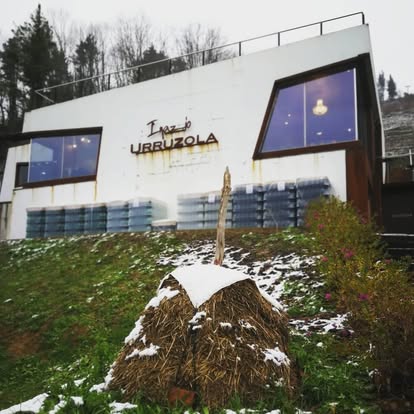
The Urruzola estate at Garaikoetxea sits at the foot of Mount Hernio in Alkiza, Gipuzkoa, where the Cantabrian ocean breeze meets the mountain air in what the family describes with devotional precision as something that cuddles the slopes, giving their vineyard its remarkable touch. This is a specific hillside. It has a specific character. But its character as a vineyard hillside was not inherited. It was discerned. The family read the land — its aspect, its elevation, its particular air — and made a judgement that this ground could carry the vine. And then they planted it, and waited, and tended, and discovered that they were right.
This act of discernment is itself theological. The land was not predestined to be a vineyard. The calling was to see what the land could become and to bear the cost of its becoming. The Hondarrabi Zuri vine is slow to establish. The first harvests are uncertain. The wine it produces is exquisitely sensitive to the character of each season, each plot, each year’s peculiarities. The Urruzola family treats every harvest according to its individual character, fermenting separate plots independently so that the distinct voice of each is preserved rather than averaged into a commodity. This is Isaiah’s logic translated into practice: attentive, faithful, patient love of a specific place, offered without guarantee of return.
What Cannot Be Sold: The Vineyard as Identity
The Lord forbid that I should give you the inheritance of my fathers.
1 Kings 21:3Naboth’s refusal is one of the most compressed moral statements in the Hebrew Bible. King Ahab wants the vineyard. He offers a fair price — even a better vineyard in exchange. His request is, by any commercial measure, reasonable. Naboth’s refusal is not. It is not negotiable, not flexible, not open to counter-offer. The vineyard is the inheritance of his fathers. To sell it — even advantageously — would be to sever himself from the ground of his identity. Some things, Naboth insists at the cost of his life, are not for sale.
The Urruzola family stands in this tradition, but with a complication that makes their story richer. They were not defending a vineyard they had inherited. They were creating one. The inherited thing — the orchard, the cider tradition, the apple — they chose to set aside. What they were defending, with the same absolute conviction Naboth shows, was something more intangible: the Basque wine, the cultural inheritance, the particular expression of lurraldea that only Txokoli carries. They could not inherit a vineyard that did not yet exist on their land. So they planted one.
Naboth’s faithfulness was conservative: preserve what has been given. The Urruzola faithfulness was creative: make possible what is at risk of being lost. Both are forms of the same conviction — that the land and what it carries are covenants, not commodities.
The orchard was the easier path. The vineyard was the necessary one. They chose the necessary one, and in doing so they became defenders not of what they had received but of what they believed must survive.
Abiding in the Right Vine: The Courage of Specificity
I am the true vine… Remain in me, as I also remain in you. No branch can bear fruit by itself; it must remain in the vine.
John 15:1, 4The force of Jesus’ claim in John 15 is often softened by familiarity. But consider what it insists: not all vines are equal. There is a true vine, and there are other vines, and to remain in the wrong vine — however comfortable, however productive, however well-established — is to remain in something that cannot ultimately bear the fruit you were made to bear. The call of John 15 is not to vines in general. It is to this vine. Specificity is the point.
The Urruzola family had a vine. The apple is a real tree, a generous tree, a tree with its own deep roots in Basque agricultural culture. But it was not the vine they were called to. The heart pushed them toward the grape — toward the Hondarrabi Zuri specifically, toward this hillside, toward this wine. They were not simply switching crops. They were responding to a particular calling toward a particular expression of a particular place’s identity.
There is a harder implication here for those willing to follow it. To abide in the true vine is not merely to persist. It is to release whatever you are currently abiding in that is not the true vine. The disciples left the nets. Abraham left the household. The Urruzola family left the orchard. The act of releasing the good thing is not a loss but a precondition: you cannot fill your arms with what is being offered if they are already full of what you already have.
The Vine That Almost Died: Lamentation and Restoration
You transplanted a vine from Egypt… It took deep root and filled the land… Why have you broken down its walls?
Psalm 80:8–9, 12Psalm 80 is the lament of a people who have watched their vine be destroyed. The psalmist does not pretend equanimity. There is anguish here, genuine bewilderment at how something that was once so full of life and promise has been reduced to its current state. The vine that filled the land, whose branches reached to the sea, is now cut down and burned. The prayer for restoration is desperate because the loss is real.
The Txokoli story moves through this arc with painful fidelity. Phylloxera first, devastating the Basque vineyards in the late nineteenth century. Then industrialisation, pulling families away from the land into the factories of Bilbao and Eibar. Then Francoism, suppressing the Basque language, making the expression of Basque identity dangerous, allowing the distinctive agricultural traditions of the region to contract toward extinction. By the mid-twentieth century Txokoli had been reduced to a handful of family operations regarded by many as a curiosity — the rough wine of elderly farmers, barely drinkable, almost gone.
The psalmist’s prayer is answered, in this story, by the people who loved the vine enough to plant it again. The Urruzola family looked at a dying wine and decided that the heart’s call was louder than the logic of the easier path. They transplanted the vine onto new ground. They cleared the stones. They waited for it to take root.
The vine took root. It filled the land again. And now Inazio Urruzola Txakolina is exported to Japan, Germany, and the United States — the family raising a glass with friends across the world while remaining entirely, defiantly rooted in Alkiza. This is what restoration looks like when it is accomplished not by miracle but by faithfulness. Slowly, quietly, one cleared hillside at a time.
Under the Vine: The Peace That Rootedness Makes Possible
Everyone will sit under their own vine and under their own fig tree, and no one will make them afraid.
Micah 4:4The biblical image of shalom — the deep peace of rightness between a people and their ground — is always specific. It is not peace in the abstract. It is your own vine, your own fig tree. The peace comes from being in the right place, tending the right ground, living within an inheritance that fits you. It is the peace of a branch that has found its vine and remained in it.
The txoko of the Basque Country — the private gastronomic societies where Txokoli is poured and shared among friends who belong to one another and to this place — is the closest contemporary analogue to this image that the culture of food and drink has produced. No one needs to explain themselves here. The familiarity is so total that it requires no maintenance. This is what the Urruzola family celebrates when they speak of making their wine as a way of celebrating life itself, toasting with the whole world while remaining utterly themselves: the shalom of people who chose the right vine, tended it faithfully, and discovered that the fruit of faithfulness is joy.
It is worth sitting with the particular quality of that joy. It is not the joy of having played it safe. The Urruzola family did not play it safe. They pulled up the apple trees. They planted on uncertain ground. They chose a wine that was nearly extinct over a tradition that was alive and well. The joy on the other side of that choice is the specific, grounded, unshakeable joy of people who answered a call and found that the call was true.
What the Apple Trees Know
There is a question that the Urruzola story poses to everyone who hears it, and it is not a comfortable one. It is this: what is the apple orchard in your life? What is the good, established, productive, respectable thing you are tending that is not the thing you are called to? What would you have to clear to make room for the vine?
The biblical tradition is unanimous on this point, and it is not sentimental about the cost. Abraham lost his country. The disciples lost their livelihood. Naboth lost his life. The Urruzola family lost their orchard. The structure is the same: the call requires a clearing. The vineyard cannot be planted in ground that is already full of apple trees. Something has to go.
The Hondarrabi Zuri grape now grows on a hillside that was once an apple orchard. The ocean breeze moves through its leaves in the same way it always did. The fourteenth-century farmhouse at Garaikoetxea still stands, its sixteenth-century winepress still in use, its walls still holding the memory of every season that has passed through them. And in the cellar, the new vintage is resting, carrying within it the character of this specific ground, this specific climate, this specific family’s faithfulness to a call they heard in the heart.
The psalmist prays for the vine to be restored. The prophet sees everyone sitting under their own vine without fear. Jesus says: remain in me, and you will bear much fruit. The Urruzola family pulled up the apple trees and planted a vineyard on a hillside in Alkiza — and the wine they make is the taste of what happens when someone hears the call and answers it.
Drink it slowly. There is a lot in the glass.