
 on February 26, 2026
Pamplona · Faith · Spectacle · Blood
Holy Chaos: When the Saint Steps Aside for the Bull
On the spiritual sediment beneath San Fermín — and the Basque thinkers who mapped it
The Same Streets, Hours Apart
At dawn on the seventh of July, a statue is carried through the streets of Pamplona. Candlelight. Clergy in white and gold. Citizens pressed along the old stone walls, some with heads bowed, some with hands folded, some simply watching with the particular stillness of people in the presence of something they cannot entirely explain. The city is quiet. The air smells of incense and the faint residue of last night’s wine.
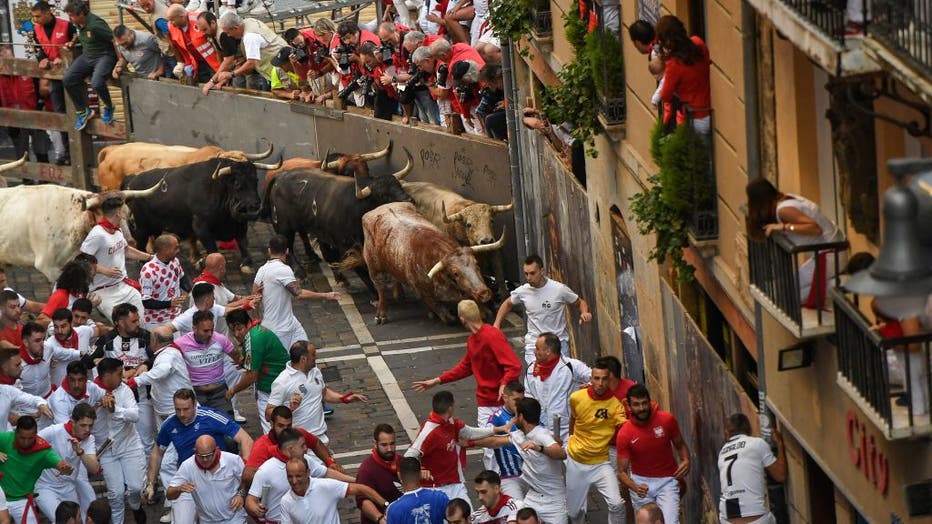
By midmorning, those same streets will be packed with ten thousand bodies in white shirts and red scarves, many of them drunk since before sunrise, the air electric with a collective madness that has been building since the first rocket fired. And then the gates open, and the bulls come, and for approximately three minutes and thirty seconds, mortality is not a concept — it is a fact, immediate and horn-shaped, thundering across cobblestones slick with the morning dew and the spilled drinks of the night before.
This is not a contradiction. It is not a tragedy of secularization, not evidence of a tradition corrupted by tourism and hedonism. It is, I will argue, the most theologically honest thing Spain does all year — a festival that refuses to pretend that faith and the flesh, the sacred and the animal, the eternal and the immediate, can be cleanly separated. And to understand why, we need to call upon a small group of philosophers, sculptors, and writers who were born into this same tension and spent their lives inside it.
The Saint Nobody Talks About
His name is known across the world. His story is known almost nowhere.
Fermín was, by tradition, the son of a Roman senator in Pamplona — a man of privilege and position who converted to Christianity in the third century and was subsequently executed for it. He became the first bishop of the city, was ordained in France, returned to preach, and was beheaded, probably around 303 AD, during the Diocletian persecutions. He was, in other words, a man of radical conviction — someone who chose death over silence, who looked at the forces of imperial power and refused to bend.
The irony of his afterlife is almost unbearable. His name is internationally famous, his festival draws a million visitors a year — and almost none of them could tell you a single fact about him. Ernest Hemingway must bear some of the responsibility. The Sun Also Rises, published in 1926, sent generations of young Americans to Pamplona in search of Jake Barnes’s ruined glamour and Brett Ashley’s catastrophic beauty. Hemingway immortalized the spectacle. He erased the theology entirely.
Miguel de Unamuno — who we will meet properly in a moment — wrote with bitter clarity about Spain’s tendency to be more comfortable with the performance of faith than its actual demands. A nation that has built more churches per capita than almost any other, and yet. The festival of San Fermín is Unamuno’s observation made annual and public: the saint is honored in procession, and then, for eight days, almost entirely forgotten.
Has San Fermín become a brand? And if so — would the saint mind? A man who died rather than be silent might find something clarifying in a city that cannot stop making noise in his name.
Layers Beneath the Cobblestones
Before there was a saint, there was a goddess. Before the Christianity that San Fermín brought to Pamplona, the Basque people had a spiritual world of extraordinary complexity and persistence — one that the Church never fully displaced, only incorporated, papered over, or drove underground.
Chief among the Basque deities was Mari — goddess of storms and mountains, a force of nature in the most literal sense. She was not a benevolent mother-figure. She was untameable, sudden, and absolute. She lived in the peaks above the valleys where people tried to build their lives, and her presence was felt in wind and thunder and the unpredictable violence of the natural world. The Christianity that came to the Basque Country did not so much defeat Mari as find an awkward accommodation with her. You can still feel her, scholars of Basque mythology argue, beneath the surface of the most Catholic celebrations.
And then there is the bull. In cultures across the ancient world — Minoan, Mesopotamian, Iberian — the bull was a sacred animal, a vessel of divine force, a creature that stood at the threshold between the human world and something larger and wilder. When the young men of Pamplona run before the bulls each morning, they are participating in a ritual whose Christian overlay is relatively recent. The instinct beneath it — the deliberate proximity to an overwhelming natural force, the bodily confrontation with something that could kill you — is older than any saint.
San Fermín does not sit atop a simple Christian foundation. It sits atop centuries of spiritual sediment: Roman, Christian, and something older and Basque and pre-linguistic underneath it all. The red scarf may honor a martyr’s blood. But the compulsion that drives a person in front of a bull at seven in the morning preceded the martyr by a very long time.
Unamuno’s Agony — Faith That Cannot Rest
Philosopher, novelist, rector of the University of Salamanca. Author of The Tragic Sense of Life. Exiled twice. On October 12, 1936, he stood up in his own university and told a Fascist general: “You will win, but you will not convince.” He died under house arrest eleven weeks later.
In The Tragic Sense of Life, Unamuno argued that the defining condition of human existence is an irresolvable war between two parts of ourselves. The rational mind — cold, clear, honest — knows perfectly well that we are mortal. It has done the mathematics. It accepts the evidence. The universe is indifferent, consciousness is temporary, and death is not a transition but a terminus. This is the conclusion of reason, and reason cannot be argued out of it.
But the heart — the will, the desire, the hunger to persist — cannot accept this. It refuses, on every level, to believe that the self will simply cease. It reaches for God, for meaning, for permanence, not because evidence supports it but because the alternative is intolerable. This is not irrationality. It is the deepest fact of being human.
Unamuno called this permanent conflict la agonía — not agony in the sense of suffering, but in the original Greek sense: a struggle, a contest, an ongoing fight. He was himself a tormented Catholic who could not live with God and could not live without him. He did not resolve this tension. He insisted, with great force, that resolution was a lie — that anyone who claimed to have found peace in either pure faith or pure atheism was avoiding the truth of their condition.
His Basque roots matter here. This was not philosophy imported from a comfortable Parisian study. Unamuno was formed by the same northern Spanish cultural world that produces San Fermín — a world in which ancient and modern, sacred and physical, faith and doubt have always existed in uncomfortable proximity.
Apply his thesis to the festival and something clarifying happens. San Fermín doesn’t resolve the tension between sacred and profane — it performs it, publicly, annually, in the streets of a city that knows exactly what it is doing. The solemn procession at dawn is not hypocrisy. The chaos that follows is not betrayal. They are both honest. They are both necessary. The drunk reveler in the red scarf, stumbling through streets named for a martyr, is not betraying Unamuno’s thesis — they are living it.
Anyone who claimed to have found peace in either pure faith or pure atheism was, for Unamuno, avoiding the truth of their condition. The festival of San Fermín is a city that has stopped trying.
After Unamuno, The Tragic Sense of LifeOteiza’s Void — The Sacred Empty Space
Sculptor, theorist, poet, Basque nationalist. One of the most important artists of 20th-century Spain. Abruptly stopped making sculpture in 1959, convinced he had arrived at the logical endpoint of his own work: pure emptiness.
Jorge Oteiza was obsessed with a particular kind of hole. Not a gap or an absence but a presence — a void so carefully shaped that it became the most important thing in the room. His sculptures pull matter back from space until what remains is an emptiness that hums with intention. He called it the unidad maleable del espacio — the malleable unity of space — and he believed it was the deepest form of spiritual expression available to the modern artist.
His key to understanding this came from archaeology. The ancient Basques built stone circles — cromlechs — across the hills of the Pyrenean foothills. Oteiza studied them with the intensity of a religious scholar. His conclusion: these were not monuments in any conventional sense. They were containers. Their function was to create and protect a sacred interior emptiness — a void that was itself the divine, or the closest humans could get to it. The stone was not the point. The space inside the stone was the point.
Oteiza believed that modern life — and modern art — was a continuous flight from this void. We fill every silence with noise, every space with object, every moment of stillness with sensation. Not because we are enjoying ourselves but because we are afraid. The void, when you actually sit in it, confronts you with everything you would prefer not to know about yourself and your situation.
Apply this to San Fermín and the critique almost writes itself. Here is a festival of maximum sensation — a million people, total noise, every nerve alive for eight days straight. If Oteiza is right, the festival is the ultimate flight from the void: the most elaborate distraction ever constructed, wearing a saint’s name as costume.
But there is a counter-argument, and it is a serious one. The person standing in the street at six in the morning, before the rockets fire, before the bulls come — that person is in a particular state. Not drunk, or not only. Waiting. Aware of their body in an unusual way. Aware, specifically, of the fact that in a few minutes they may be in very serious danger. In those minutes before the run, the void opens. Death becomes present. The stone circle reasserts itself in the most unexpected setting imaginable.
Perhaps the void and the chaos are not opposites after all. Perhaps you need one to find the other.
Chillida’s Tension — Forces That Cannot Be Reconciled
Sculptor. Trained as an architect. His works are installed across the world — in front of the Reichstag in Berlin, in the Louvre, in the United Nations. His masterpiece, El peine del viento (The Comb of the Wind), is anchored into the rock at the mouth of the Bay of Biscay in San Sebastián, where the Atlantic meets the coast of the Basque Country.
Go to San Sebastián on a stormy day and stand on the rocks at the end of the Ondarreta beach, below the Monte Igueldo. Three massive iron sculptures emerge from the rock at the edge of the sea — Chillida’s El peine del viento. They are not graceful. They are not resolved. They reach toward each other and do not meet. They are anchored into stone and yet they seem to pull against it. When the Atlantic swell comes in — and in winter it comes in with enormous force — the water surges through channels cut in the rock beneath the sculptures, and the sound is like something breathing.
Chillida spent his entire career on a single problem: the relationship between opposing forces. Weight and weightlessness. Matter and void. The made thing and the natural world into which it is placed. He never sought resolution. He sought — and this is the crucial point — the most honest expression of irresolvable tension. His sculptures do not tell you that everything will be fine, that the opposites will eventually harmonize. They tell you that the tension is permanent, that it is real, and that living honestly means finding a way to inhabit it rather than escape it.
This is the lens through which San Fermín becomes something other than a contradiction or a problem. Faith versus spectacle. Sacred versus profane. Life versus death. The saint versus the bull. These are not competing claims that need to be adjudicated — they are the arms of a Chillida sculpture, reaching toward each other across an unbridgeable distance, creating between them a space that hums with meaning precisely because it cannot be resolved.
The festival does not need to choose. It never has. Its power — the reason it has persisted for seven centuries and drawn people from every corner of the world — is that it holds the tension without flinching. It is, in this sense, a monument. Not to faith, and not to hedonism, but to the human capacity to live inside irresolvable contradiction and call it home.
Chillida never sought resolution. He sought the most honest expression of irresolvable tension. San Fermín is a city that has built a festival on the same principle.
Zubiri’s Religación — Why We Still Show Up
Philosopher. Studied under Husserl and Heidegger. Taught briefly in Madrid before the Civil War forced him into exile. Returned to Spain and spent decades in private study, eventually producing a trilogy on intelligence and reality that is among the most rigorous philosophical works of 20th-century Spain.
Where Unamuno was volcanic, Zubiri was precise. He was not interested in the drama of faith — he was interested in its structure. And what he found, after decades of careful philosophical work, was that the question of God and religion could not be answered at the level of belief or doctrine. It had to be answered at a deeper level: the level of what he called religación.
Religación — from the Latin religare, to bind — was Zubiri’s name for a feature of human existence so fundamental that it precedes any choice about faith. Humans are, he argued, constitutively bound to a reality greater than themselves. We did not make ourselves. We find ourselves thrown into existence, dependent on conditions we did not choose, sustained by forces we do not control. This dependency is not a religious claim — it is a description. And the response to it — the reaching toward whatever grounds and sustains us — is not optional. It is what it means to be human.
The implications for San Fermín are quietly radical. The tourist who comes for the party, the local who comes for the saint, the runner who comes for the adrenaline, the philosopher who comes for the spectacle of the human condition in concentrated form — all of them are responding to the same underlying pull. They are naming it differently. They are experiencing it differently. But the structure of their response is the same: a reaching toward something larger, something that exceeds the ordinary boundaries of individual life.
This is why the festival survives secularization so robustly. It does not require conscious belief. It does not ask you to sign any doctrinal statement. It operates at the level Zubiri identified — below belief, below doctrine, in the bedrock of human experience. You show up. You are swept into something larger than yourself. You are, for a few days, relieved of the burden of being only you.
The drunk reveler in the red scarf, on this reading, is not mocking the saint. They are, in their own chaotic way, a Zubirian pilgrim.
Atxaga’s Question — What Survives When Meaning Is Forgotten?
The pen name of Joseba Irazu Garmendia. The most widely translated Basque writer in history. His novel Obabakoak (1988) won the Spanish National Prize for Literature and brought Basque literature to an international audience for the first time.
Atxaga writes about a particular kind of loss — not the dramatic loss of catastrophe, but the quiet, almost invisible loss of connection between a living culture and its own roots. His characters move through a Basque Country in which the old myths, the old language, the old ways of understanding the world persist in fragmentary form — embedded in place names, in folk stories, in habits whose original meaning has long been forgotten. They are surrounded by the shells of meaning without the living content that once animated them.
His central anxiety is this: what remains of a tradition when the original connection to its source is severed? The words are still spoken, the ritual still performed, the costume still worn — but by whom, and why, and toward what? Is a tradition that has lost its meaning still sacred? Or has it become, as Atxaga might put it, a beautiful and hollow thing — a language that everyone speaks and no one understands?
This is perhaps the sharpest question San Fermín raises, and the one the festival’s defenders are least comfortable with. The procession still moves. The prayer is still said. The red scarf is still tied around a million necks. But the young woman from London who ties hers on has no idea she is wearing a martyr’s blood. The young man from Tokyo who runs with the bulls has never heard of Fermín, let alone of his conviction or his death. The meaning, if it is there, is not being transmitted.
And yet — and this is where Atxaga’s anxiety becomes genuinely interesting — something is still happening. The collective body of the festival generates something that resembles meaning even in the absence of explicit content. People leave changed, or say they do. People who came for the party find themselves, unexpectedly, in the procession at dawn, moved by something they cannot name.
Maybe meaning was never fixed. Maybe the festival has always been making itself up as it goes — a ritual container that each generation fills with its own grief and joy and hunger, regardless of what the previous generation put there. If so, then Atxaga’s anxiety, though real, may be answering the wrong question. The tradition does not survive by preserving its original content. It survives by remaining a place where humans can bring what they cannot say elsewhere.
The Bulls as Theology — Death in the Afternoon
Every night of the festival, in the Plaza de Toros de Pamplona, bulls die. Six of them, in the tradition of the corrida — three fights of two bulls each, the whole elaborate ritual of tercio de varas and tercio de banderillas and the final estocada, the sword. It takes approximately twenty minutes per bull, from entrance to death.
The running of the bulls in the morning exists, at its origin, to move those bulls from their overnight corrals to the ring where they will die. This is sometimes described, by people uncomfortable with the festival’s violence, as incidental. But it is not incidental. It is the liturgical structure of the day: the running is the procession, the ring is the altar, and the death is the sacrifice.
Consider the parallel with the saint himself. Fermín was a man who faced death without flinching, in a city that now, annually, stages a confrontation with death as its central spectacle. The runners in the Encierro are not consciously reenacting the martyr’s choice. But the resonance is there for anyone who wants to find it: the deliberate proximity to something that could kill you, the refusal to look away, the body placed in the path of an overwhelming force.
Unamuno insisted that the tragic sense of life requires death to be present — not sanitized, not sentimentalized, not managed at a comfortable distance, but present and immediate and real. San Fermín delivers this every morning and every evening. The bull is not incidental to the festival’s spiritual content. It may be, in a very uncomfortable sense, its most theologically honest element — the one place where the festival stops performing mortality and actually confronts it.
The bull is not incidental to the festival’s spiritual content. It may be its most theologically honest element — the one place where the festival stops performing mortality and actually confronts it.
The Locals vs. The Spectacle
Ask a Pamplonan what San Fermín means to them and you will get, depending on their generation and disposition, some combination of the following: family, faith, identity, the smell of the city in July, a particular bar, their grandfather, the sound of the txistularis playing in the plaza, the way the gigantes look when they turn. It is, for them, the anchor of the year — the point around which the rest of time organizes itself.
Ask a tourist from Ohio or Shanghai what San Fermín means to them and you will get: the running, the party, Hemingway, the red scarf, the Instagram photo. It is, for them, a bucket list item — an experience to be consumed and taken home and shown to friends.
This is Atxaga’s anxiety made flesh, every July, at scale. When outsiders consume a sacred tradition as entertainment, does the tradition survive — or merely its costume? The festival has become so globally famous that the tourists now vastly outnumber the locals, particularly in the first days. The city of Pamplona has a population of around 200,000 people. The festival draws close to a million visitors. The mathematics of this are not neutral.
And yet. Zubiri’s point holds even here. Even the tourist is religado — bound to something they cannot fully name. The person who came for the party and finds themselves standing in the old city at midnight, surrounded by people singing songs they don’t understand, feeling something that exceeds their capacity to explain it — that person is having a genuine experience. It may not be the experience the locals are having. But it is real.
The festival absorbs everyone. It has been doing so for centuries — pilgrims, merchants, aristocrats, peasants, and now influencers. This absorptive capacity may be its greatest spiritual feat: the ability to remain, in some essential way, itself, even as the people who fill it change utterly.
The Saint Is Still There
On the evening of July 14th, at the end of the festival, the people of Pamplona gather in the Plaza Consistorial and sing Pobre de mí — “Poor me, poor me, how sad it is that the festival of San Fermín has ended.” They hold their red scarves above their heads and wave them in the dark, and some of them cry, and all of them mean it, in the way that only the end of something beautiful can be genuinely meant.
The statue of San Fermín has already been returned to his chapel. He is there now, in the quiet of the Iglesia de San Lorenzo, as the city roars its final roar outside. He has been there all week, in a sense — present beneath the noise, the way the pre-Christian goddess Mari was present beneath the Christianity that came to displace her, the way Oteiza’s sacred void persists beneath every effort to fill it.
Unamuno and Oteiza and Chillida and Zubiri and Atxaga were all, in their different ways, circling the same fire. The fire that burns at the center of San Fermín, and at the center of Basque culture, and at the center of the human condition: the irresolvable tension between what we know and what we need, between mortality and the refusal of mortality, between the flesh and whatever the flesh is reaching for.
The festival does not resolve this tension. It has never tried to. It simply holds it, year after year, in the streets of a small city in northern Spain, inviting anyone who wants to come and stand inside the contradiction for a while.
Perhaps faith has always required spectacle to survive in the public square. Perhaps the saint understood this better than we give him credit for — a man who chose the most public possible death, who made of his dying a spectacle that people are still, seventeen centuries later, running in the streets to honor.
The statue is returned to his chapel. The city will not sleep for another eight days. He watches, quietly, and is — one imagines — not surprised at all.