
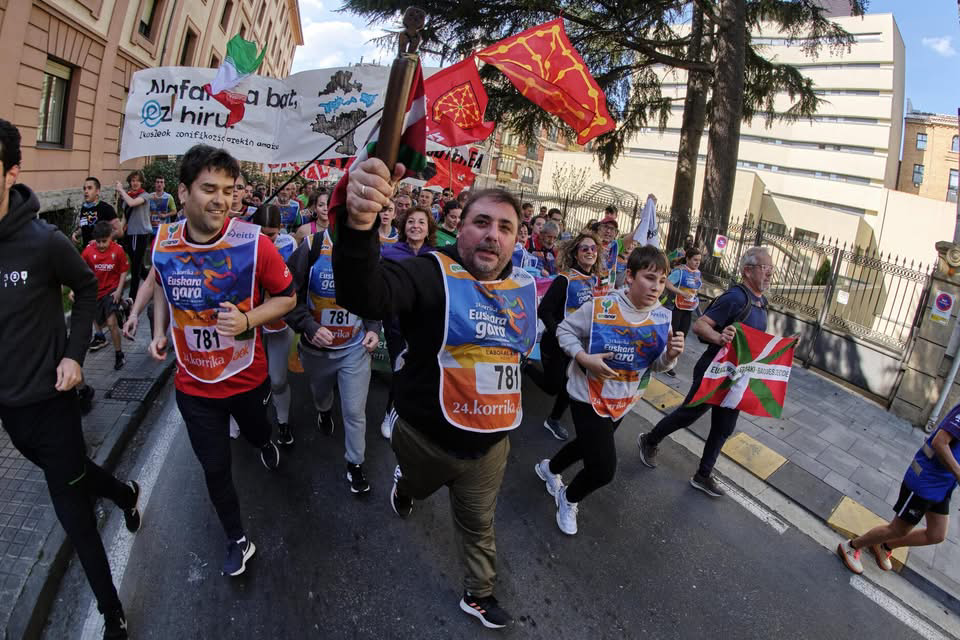
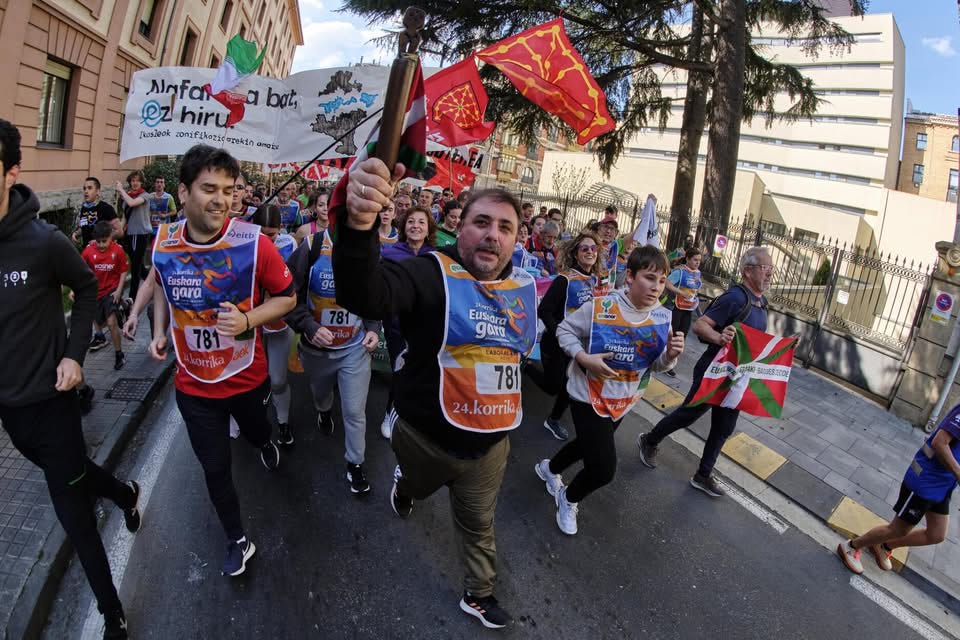
Every two years, something extraordinary sweeps across the Basque Country. Day and night, without pause, a wooden baton passes from hand to hand across more than two thousand kilometres of roads, mountains, villages, and city streets. Children wait at roadsides in the early hours of the morning. Bands play in town squares. Hundreds of thousands of people — young and old, native speakers and learners, locals and newcomers — take their turn to run. This is Korrika, one of the most remarkable cultural events in the world. And in 2026, it runs under a slogan that captures everything it stands for: Euskara gara — We are the Basque language.
The Language That Defied History
To understand Korrika, you first have to understand Euskara. Basque is one of the oldest languages in Western Europe, predating the Indo-European tongues, and its origins remain a mystery — it has no known relation to any other language on earth. It has survived Roman invasions, centuries of political pressure, and the slow erosion of modernity. But its most brutal test came in the twentieth century.
During Francisco Franco’s dictatorship (1939–1975), the Basque language underwent a rapid decline through a long period of oppression in Spain. Basque people were even punished by the Spanish police for speaking the only language they knew in public. In schools, children were forbidden from using it. The language was framed as backward, as a barrier to progress. A generation grew up in silence.
But Euskara endured — and the people who carried it refused to let it die quietly.
The Birth of Korrika
Concerned by the weakening of the language, people started creating clandestine organisations where Basque was taught. The newly created Basque movement put together the association AEK — Alfabetatze Euskalduntze Koordinakundea — for the teaching and alphabetisation of the language.
Once the dictatorship ended, a group of Basque activists turned their energy into something bold. Korrika, which means “running” in Basque, started in 1980. The first race took place between Oñati, Gipuzkoa and Bilbao, Bizkaia over the course of 9 days, starting on November 29th and ending on December 7th. The idea was simple but visionary: instead of gathering crowds in one place, they would carry the cause to the people — every town, every village, every corner of the Basque Country.
The first edition set off, among criticism on the “foolishness” of the idea, in Oñati on 29 November 1980. The critics were wrong. What began as a grassroots act of linguistic defiance has since grown into one of Europe’s most powerful cultural movements.
How Korrika Works
The mechanics of the race are as meaningful as its message. In order to raise funds for the promotion of the Basque language, each kilometre of the race is “sold” to a particular individual or organisation, who will be the figurehead of the race during their purchased kilometre. This race leader relays a wooden baton, preserved from the first race held, and adorned with the Basque flag.
Every edition, the organisers of Korrika include a secret message in the baton, which is read at the end of the festival, after it has been passed hand by hand through thousands of Basque speakers. The reading of that message — by a chosen Basque author or cultural figure — is one of the race’s most anticipated moments. The message is a kind of love letter to the language and its people, composed in darkness and unveiled in celebration.
Behind the race leader, the immediately following participants carry a banner bearing the race slogan, that changes on every edition. The race is conducted in an extremely jovial, uncompetitive spirit, accompanied by music and general fanfare, with roads thronged with spectators. This is emphatically not a competition. There are no winners, no finish-line medals — only the act of running together, of showing up.
Euskara Gara: The 2026 Edition
The 24th edition of Korrika, held from March 19 to 29, 2026, runs under the slogan Euskara gara — “We are the Basque language” — departing from Atharratze (Tardets) in the Soule region of the French Basque Country and concluding in Bilbao.
The choice of slogan is both a statement and an invitation. Korrika carries the slogan Euskara Gara because Basque is understood as something that brings society together — not as a barrier but as a source of encouragement and a meeting point. The language is seen as a bridge between people of different backgrounds, whether born here or coming from elsewhere, and as a tool for social cohesion that strengthens mutual care, social justice, and a sense of community.
The starting point this year carries special weight. The Soule region, and in particular the Basabürüa area where Tardets sits, is one of the places where Euskara is most endangered. Choosing it as the launch point is an act of solidarity — a declaration that no corner of the Basque Country will be left behind.
The message of the 2026 edition is clear: everyone has value, and every speaker is important — those who have enrolled in language classes, those whose first language is Basque, those who have come from abroad, those who want to learn and live in Basque. We are all one people. We are Euskara.
A Global Phenomenon
What started as a local act of resistance has become something far larger. Korrika has become a worldwide phenomenon, with runs wherever there are Basques. In 2024, many cities across the globe participated, from Reno to Tokyo, and from Necochea, Argentina to Lapland, Finland.
The race has also inspired imitation — the sincerest form of cultural flattery. Korrika has inspired other regions to hold similar events, including Brittany starting in 2008, Catalonia in 1993, and Wales in 2014. Minority language communities around the world have looked at what the Basques built and found in it a template for their own struggles.
Why It Matters
Korrika is not simply a race. It is a rolling referendum on identity — a collective, joyful, defiant answer to the question of whether a small language can survive in a globalised world.
Since the first Korrika between Oñati and Bilbao in 1980, the event has become one of the leading events in support of Basque, thanks to the large number of participants it attracts. Hundreds of thousands of people are estimated to have taken part in Korrika over the years, and the numbers and impact generated show just how committed Basque society is to its language.
In a world where languages are disappearing at an alarming rate — often silently, without ceremony — Korrika insists on being heard. It turns a linguistic cause into a festival, a political act into a party, and a relay race into a declaration of collective identity.
Euskara gara. We are the Basque language. And as long as people keep running, it lives.