
PREAMBLE
What This Framework Is and Is Not
This is not a church planting strategy.
It is not a missional methodology imported from another context and adapted for Basque use. It is not a program to implement, a model to replicate, or a timeline with measurable outcomes attached to quarterly reporting cycles.
It is a framework — a way of seeing, a set of convictions, a collection of practices and postures and structures that have emerged from sustained, honest engagement with the specific soil of the Basque Country and the specific questions that soil raises for anyone who believes the Gospel belongs here in a genuinely Basque form.
The framework has been built from the ground up — from the soil assessment, from the cultural engagement, from the theological tradition that grew in this specific land, from the wisdom of communities elsewhere that have learned what serves Gospel movement and what depletes it. It is offered not as a finished product but as a living document — one that will be revised, corrected, and deepened by the Basque community itself as that community grows in its capacity to lead its own movement.
The framework belongs to the Basque church. Not to the outside organization that helped articulate it. That conviction is not incidental to the framework. It is its foundation.
— — —
PART ONE
Reading the Soil
The Theological and Cultural Foundation
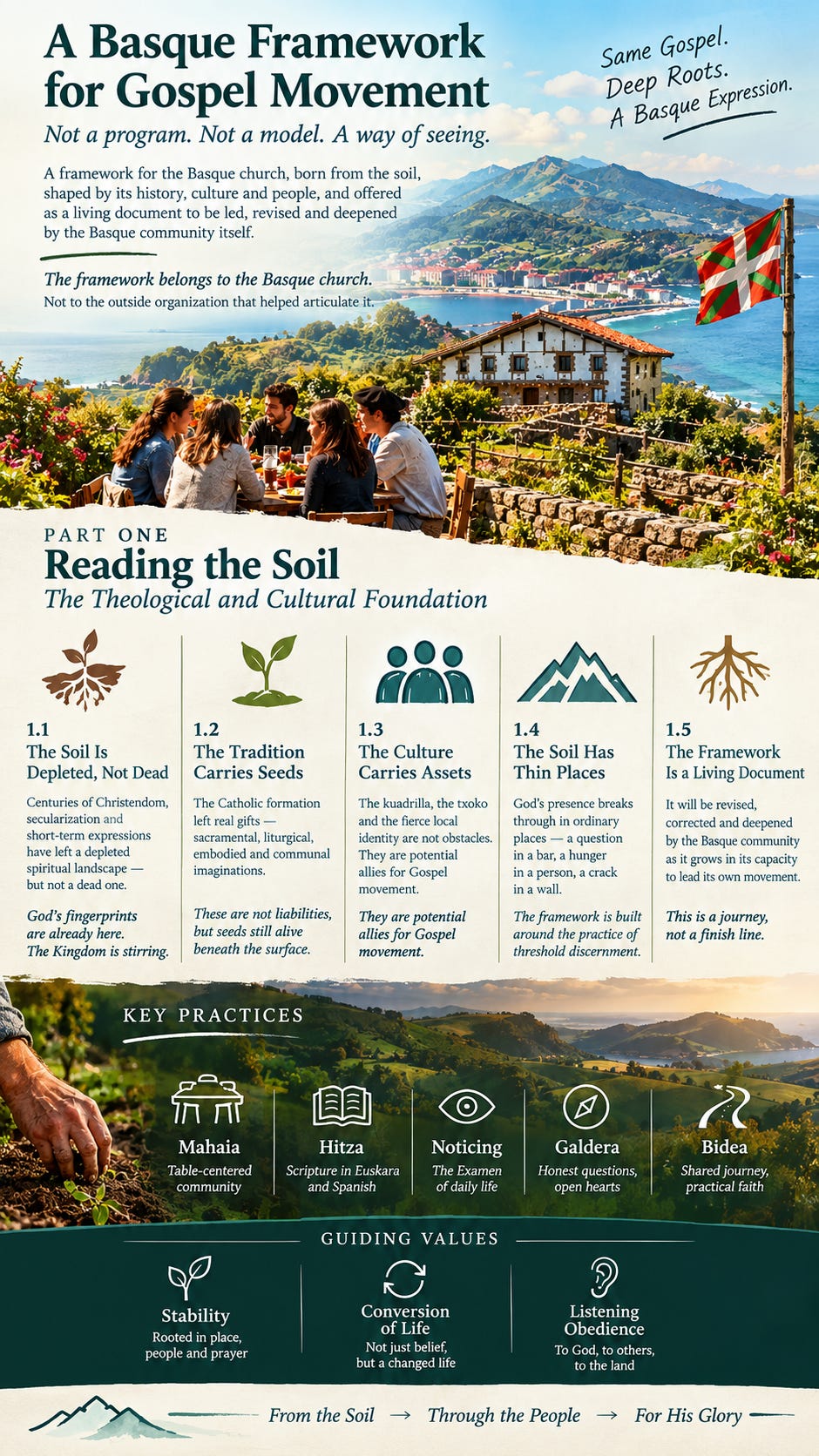
1.1 The Soil Is Depleted, Not Dead
The Basque Country has known Christianity for more than a thousand years. The faith is not foreign to this soil. But centuries of Christendom monoculture — faith as cultural inheritance, institution as mediator, the church as bearer of Basque identity through political suppression — followed by rapid secularization, followed by imported evangelical expressions that arrived with enthusiasm and left without lasting root — have produced a spiritual landscape that is depleted.
Depleted is not dead. This distinction governs everything that follows.
Dead soil requires the introduction of life from outside. Depleted soil requires the restoration of conditions that allow what is already present to flourish. The framework is built entirely on the second conviction. God’s fingerprints are already on the terrain of the Basque Country. The Kingdom is already stirring — in the hunger the disenchantment has produced, in the kuadrilla’s fierce loyalty, in the Basque refusal to be absorbed into something generic, in the questions ordinary Basque people are already asking in bars and at tables and on walks along the coast.
The framework’s first task is not to bring something new. It is to restore the conditions for what is already present to become visible.
1.2 The Tradition Carries Seeds
The Catholic formation of Basque believers gave real gifts alongside its real wounds. The sacramental imagination — the instinct for the sacred in ordinary things. The liturgical imagination — the sense that time has a shape, that life moves through seasons that mirror something deep in the nature of God and creation. The embodied imagination — the knowledge that faith is physical, that worship involves the whole self. The communal imagination — the conviction that faith is not a private transaction but a shared life.
These are not liabilities to be overcome. They are seeds — planted by imperfect vessels in imperfect soil, still alive beneath the surface, waiting for the conditions that will allow them to bear the fruit they were always meant to produce.
1.3 The Culture Carries Assets
The Basque cultural grain is extraordinarily strong — and extraordinarily useful for Gospel movement when it is honored rather than overridden.
The kuadrilla — the fierce, loyal, lifelong circle of friends that is the basic social unit of Basque life — is closer to the New Testament picture of church than most of what Western Christianity produces. The txoko — the private gastronomic society built around the preparation and sharing of meals as a form of community — is Mahaia already practiced as a cultural institution. The Basque instinct for fierce local identity, for protecting what is genuinely indigenous, for refusing to be absorbed into something homogeneous — these are not obstacles to Gospel movement. They are its potential greatest allies.
1.4 The Soil Has Thin Places
The Celtic Christian tradition used the phrase ‘caol áit’ — thin places — for locations and moments where the membrane between heaven and earth becomes unusually permeable. Where the eternal presses through into the ordinary. Where God’s fingerprints are visible on the surface of specific ordinary moments in specific ordinary lives.
The Basque Country is full of thin places. They are not in the dramatic or the religious or the obviously sacred. They are in a specific question asked in a specific bar in a specific neighborhood. In a specific hunger in a specific person whose history has brought them to a specific moment of readiness. In a specific crack in a specific wall through which light is beginning to enter.
The framework is built around the practice of threshold discernment — the communal capacity to recognize thin places, to stop and look more carefully at what catches the community’s attention, and to accompany one another toward the thresholds the thin places make available.
Ignatius of Loyola — born forty kilometers from Donostia — gave the Western church its most sophisticated practice of threshold discernment. The Spiritual Exercises, the Daily Examen, the practice of finding God in all things — these emerged from this specific terrain and belong to it. The framework recovers them for the specific formation needs of the Basque church in this specific season.
1.5 The Soil Has Plausibility Structures [NEW — SECOND ITERATION]
Thin places tell the community where God is already breaking through. Alongside that, it is worth naming a second, smaller reality: some resistance to the Gospel here has less to do with argument than with association. A plausibility structure — the term comes from sociologist Peter Berger, carried into missiology by Lesslie Newbigin — is the social world within which a belief feels reasonable or, outside of it, feels strange. A claim can be true and still feel unbelievable to someone whose history has taught them, without a single argument made, that this is not the kind of thing serious people believe.
In the Basque Country this often traces to specific histories: the fusion of Catholic institution and Basque identity, which meant institutional collapse took much of the faith’s credibility down with it; imported evangelical expressions that arrived already coded as foreign; and the kuadrilla, which can function as a rival structure that makes belief feel like a betrayal of the group — or, held rightly, as an ally that makes it feel like home.
This is a minor, supplementary diagnostic, not a replacement for thin-place noticing or a reason to soften anything. The task it adds is small: noticing, occasionally, what makes the Gospel feel foreign to a specific person, and letting that awareness shape how the table looks and feels — never what it teaches. Scripture, not social comfort, still governs what the community believes; this section only helps the community understand why a true thing might still be hard for someone to hear.
— — —
PART TWO
The Organisms
Who Is In the Framework and What They Are Doing
The framework involves three distinct organisms — each with its own role, its own formation process, its own relationship to the others. Understanding the distinction between them is essential for understanding how the framework functions as a whole.
2.1 The Rhizome — Basque-Led Communities
The primary organism in the framework is the rhizome.
In the natural world, milkweed spreads and strengthens through rhizomes — an underground root system that connects plant to plant, sharing nutrients, reinforcing stability, transferring life across the system, strengthening weaker growth, and enabling new shoots to emerge at the edges. The rhizome is invisible from above. It moves in ways that cannot be mapped from the surface. It connects what appears to be separate plants into a single living system.
In the framework, the rhizome is the network of Basque-led communities learning to follow Jesus — gathered around tables, practicing shared rhythms, developing holy imagination, taking small faithful steps in their existing relationships. These communities are the primary organism. They are indigenous. They are already moving. They are connected to each other in ways that no outside eye can fully map or manage.
The rhizome does not need the outside catalyst to exist. It is already there, already moving, already producing the underground connections that will eventually surface as visible Gospel movement.
What the rhizome needs:
- Formation — through the Raíces / Sustraiak / Roots series and the ongoing development of what that series builds.
- Connection — to each other, across the Basque Country, through relationship and shared practices.
- Autonomy — from the beginning, not as an eventual goal. The rhizome leads. Everything else exists to serve what the rhizome is doing.
2.2 The Camino — Shared Formation Journey
The Camino de Santiago passes through the Basque Country. In the framework, the Camino is the shared road that Basque believers and outside catalysts walk together — not as teacher and student, not as leader and follower, but as fellow pilgrims with different perspectives on the same terrain moving toward the same destination.
The Basque pilgrim brings:
- Deep knowledge of the terrain — culture, language, relational networks, history, wounds
- Credibility with the people the Kingdom is trying to reach
- Capacity to embody the Gospel in genuinely Basque forms
- Authority to name what is happening in their own culture
The outside catalyst brings:
- Cross-cultural pattern recognition for how the Kingdom moves
- Defamiliarization — fresh eyes that see what familiarity has made invisible
- Connection to the wider body of Christ
- A form of accompaniment that is specifically not Basque — creating a particular kind of safety
2.3 The Base Camp — The Basque Collective
The Collective is the base camp for outside catalysts. Not the summit. Not the primary organism. Base camp — the place outside catalysts return to for rest, resupply, honest community, and the specific formation they need to walk alongside rather than lead the Basque pilgrims they are accompanying.
The Collective is modeled on and modified from the KC Collective and the Chicago Collective — communities of practitioners who have discovered that their effectiveness multiplies when they stop pursuing parallel organizational agendas and commit together to the flourishing of a specific place on that place’s own terms.
The Collective’s three functions:
- Formation — ongoing formation of outside catalysts in the postures and practices the Basque context requires.
- Collaboration — structures that allow outside catalysts to pool observations and arrive at communal discernment.
- Accountability — specifically accountability to the Basque communities the Collective exists to serve.
— — —
PART THREE
The Formation Processes
Two Distinct Journeys on the Same Road
The framework involves two distinct formation processes — shaped by two distinct relationships to the terrain, producing two distinct kinds of seeing that together constitute a communal threshold discernment neither could produce alone.
3.1 Basque Formation — Raíces / Sustraiak / Roots
The formation process for Basque believers is the twelve-session series Raíces / Sustraiak — Roots — and the ongoing community life that the series builds. The series moves through four movements:
Movement One — Reading the Soil
Honest assessment of what monoculture religion has done to the spiritual landscape of the Basque Country and to the personal faith of the people gathering. Sitting with the image of exile without rushing toward resolution. Recovering what was genuinely true in the Catholic formation that shaped them. A brief, secondary note: this is also where a group might first name what has made faith feel foreign to them. [NEW — SECOND ITERATION]
Movement Two — Tending the Soil
Building a shared Rule of Life around three Basque-resonant anchors — Mahaia (the table), Hitza (the word), Bidea (the way). Learning what genuine community requires and costs. Developing the long obedience that sustains what has been built through the seasons when nothing is visibly growing.
Movement Three — Noticing the Kingdom
Developing the holy imagination that recognizes God’s fingerprints in existing relationships and everyday environments. Identifying Kingdom Catalysts — people with the natural capacity for threshold perception. Taking specific, simple, small, slow steps in response to what is being noticed.
Movement Four — Building the Trellis
Understanding why inherited structures cannot hold what God is doing. Drawing on the biblical blueprints of Jerusalem and Ephesus. Building the lightest possible servant structure that supports what the Spirit is already growing without controlling or strangling it.
3.2 Outside Catalyst Formation — The Collective’s Process
The formation process for outside catalysts is structured around the Collective’s base camp — a community of practitioners being formed together in the specific postures and practices that the Basque context requires. The process moves through four phases:
Phase One — Soil Reading
Personal reckoning with the history of outside missionary presence in the Basque Country. Honest assessment of what the outside catalyst’s own tradition has depleted and what it has genuinely given. Development of a sympathetic literacy for Catholic formation — its gifts, its wounds, its seeds still alive beneath the surface. This includes recognizing the assumptions the catalyst’s own background gave them about what serious faith looks like. [NEW — SECOND ITERATION]
Phase Two — Terrain Learning
Sustained, unhurried, agenda-free presence in the Basque Country. Learning Euskara as an act of love rather than a missional tool. Development of genuine curiosity. Building relationships with Basque cultural guides who will tell the outside catalyst the truth about when their perspective is producing misreadings of the terrain.
Phase Three — Fingerprint Literacy
Specific formation in recognizing the ways the Kingdom moves in post-Christendom contexts. Practice of the Examen of Noticing — adapted for cross-cultural thin place perception. Development of the communal discernment practice that allows what one person notices to be tested and deepened by what others notice.
Phase Four — Accompaniment Practice
Specific formation in the discipline of following before leading, asking before answering, pointing before explaining, releasing before it feels ready. Practice of the debrief — the regular structured conversation between outside catalyst and Basque facilitator where the two formations meet and threshold discernment becomes communal.
— — —
PART FOUR
The Structures
What Serves Life Without Replacing It
The framework involves three structural elements — each designed to be as lightweight as possible, each oriented toward the flourishing of the vine it serves rather than its own maintenance and perpetuation.
4.1 The Table — Primary Gathering Structure
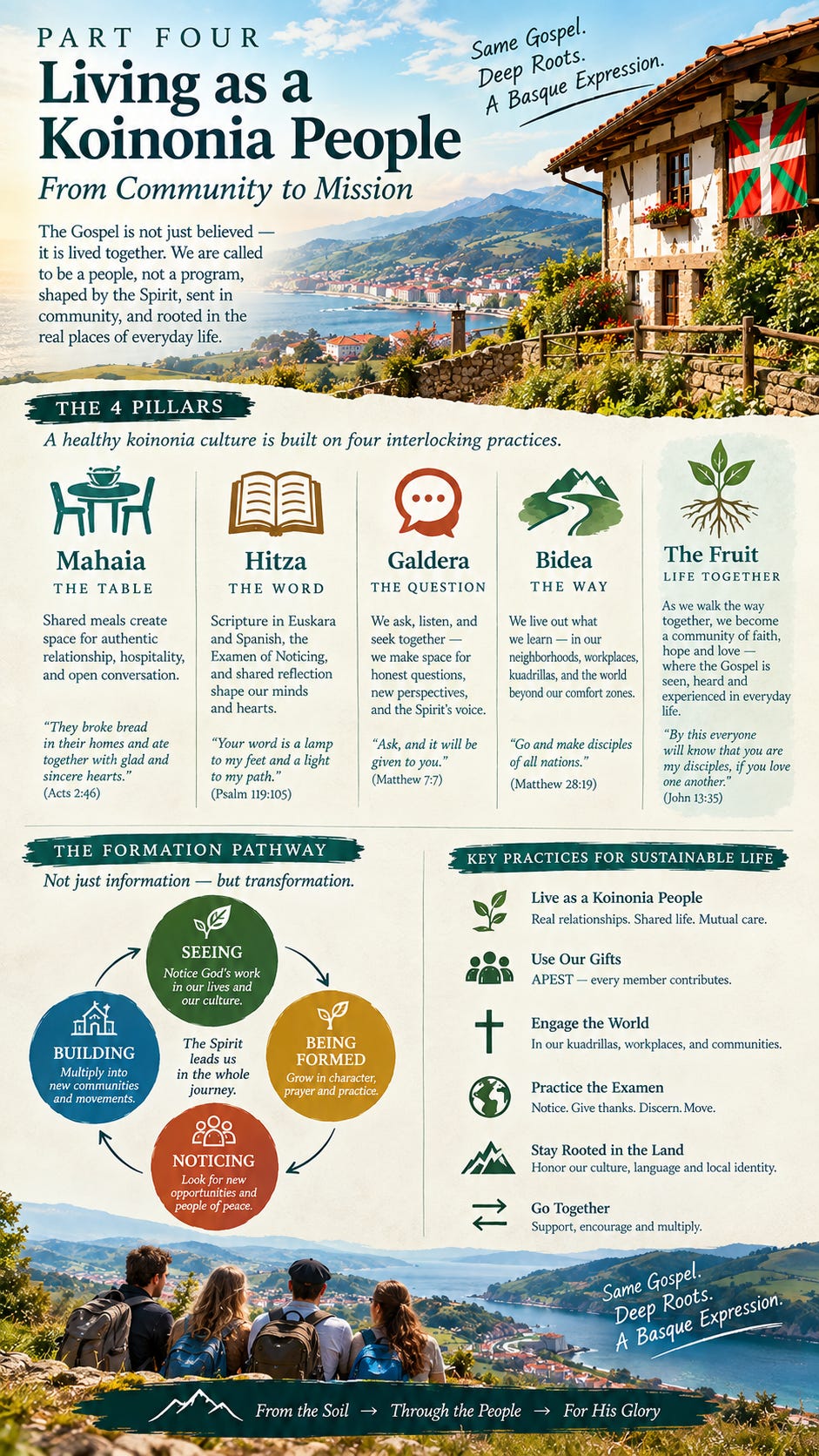
The primary gathering structure of every Basque community in the framework is the shared meal. Not a Sunday service. Not a program. Not an event. A meal — regular, unhurried, around an actual table with actual food, in someone’s home or in a txoko or in a local bar. The meal is the structure. Everything else — Scripture, conversation, prayer, discernment — happens around and through the meal rather than instead of it.
To center the community’s life around shared meals is to say — before a word is spoken — that what is forming here belongs to this culture. It is not imported. It is not a foreign transplant. It is the Gospel taking root in Basque soil.
4.2 The Rule of Life — Formation Structure
The Rule of Life is the shared agreement about how the community orients its life together between gatherings. It is built around three anchors and owned by the community rather than handed down to it.
Mahaia — The Table
Regular shared meals, the practice of extending the table to people outside the community, the specific hospitality that makes the community a place where the spiritually curious feel genuinely welcome.
Hitza — The Word
Shared engagement with Scripture that is participatory rather than lecture-based, the daily Examen of Noticing adapted from the Ignatian tradition, reading the biblical text in Euskara as an act of cultural and spiritual integration.
Bidea — The Way
Genuine accompaniment between gatherings, the specific commitment to take one small faithful step in an existing relationship before each gathering, bringing what has been noticed back to the table for communal discernment.
4.3 The Trellis — Community Structure
The trellis is the lightest possible structure that supports what the Spirit is already growing — without controlling it, centralizing it, or turning it into an old wineskin with new branding.
In the earliest season the trellis is simply the community’s shared practices and shared commitments. As the community develops the trellis grows with it — not into an institution, but into something closer to what Jerusalem had in its earliest form: a network of tables connected by shared practices and shared story and the ongoing equipping presence of the people formed in the earliest community.
The trellis at every stage is governed by four qualities:
- Servant — existing for the sake of the vine, not for its own sake.
- Lightweight — doing only what the vine actually needs.
- Indigenous — shaped by the specific vine it is serving rather than imported from another context.
- Provisional — always being tended, always ready to grow or give way as the vine requires.
— — —
PART FIVE
The Practices
What the Framework Actually Does Day to Day
5.1 Threshold Discernment
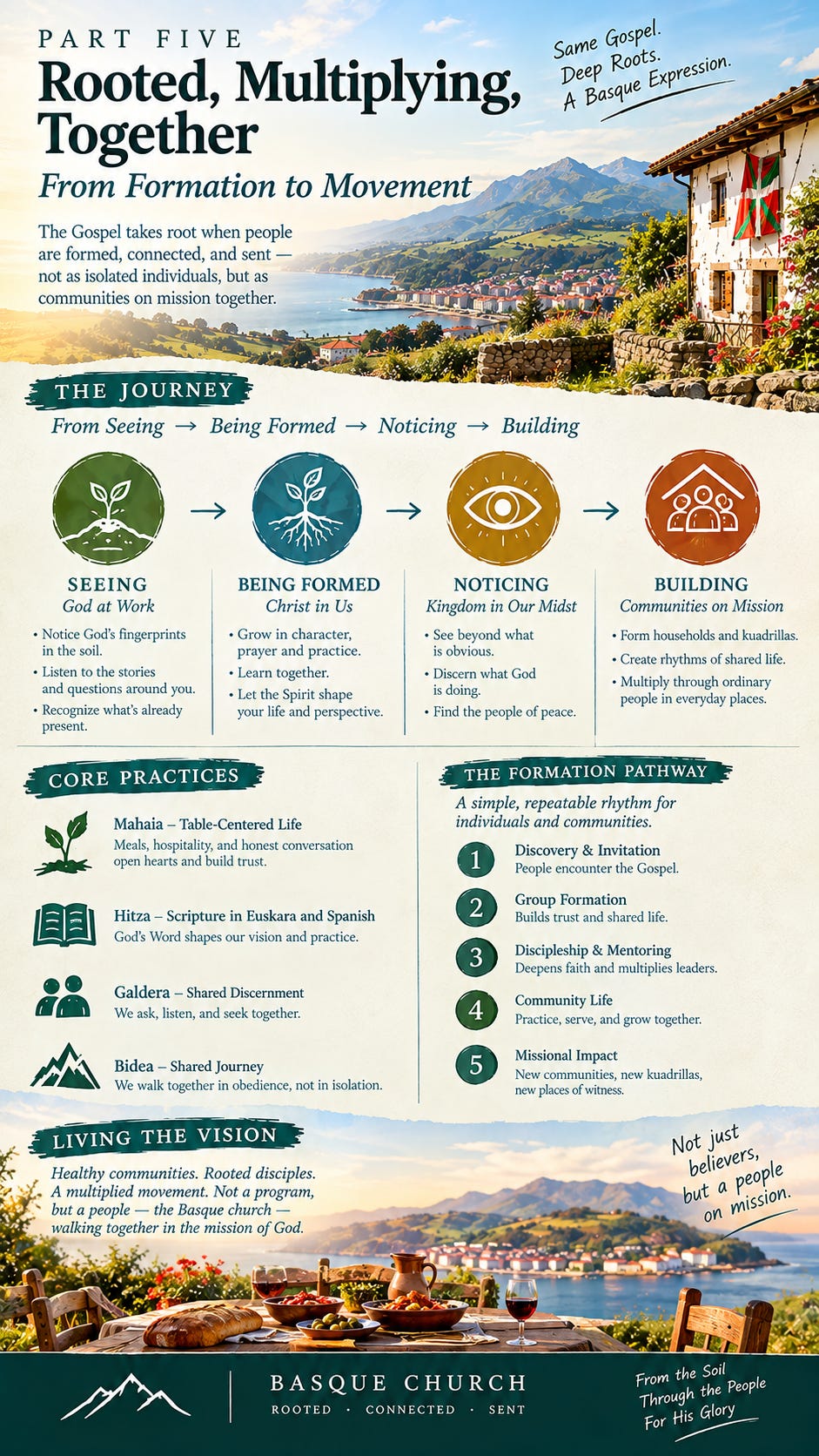
The central ongoing practice of the framework is threshold discernment — the communal capacity to recognize thin places and accompany one another toward the thresholds they make available. This practice is exercised through:
- The Examen of Noticing — practiced daily. Three questions: Who did I actually see today? Where did I sense something stirring? What is one small response?
- The Debrief — the regular conversation between Basque facilitator and outside catalyst where what each has noticed from their different angles is compared and held together.
- The Table Conversation — at every gathering, naming what has been noticed since the last gathering. Who was seen? Where did the Kingdom stir? What step was taken?
5.2 Kingdom Catalyst Recognition and Release [NEW — SECOND ITERATION]
A specific ongoing practice of the framework is the recognition and release of Kingdom Catalysts — people in the existing relationships of every community member whose natural orientation suggests that the Kingdom is already stirring in them and through them.
Kingdom Catalysts are not identified through formal assessment. They are noticed, named, and accompanied. But naming here means something more than assigning a function. Before a community asks what this person might go on to do, it is first recognizing what their life has already become — evidence, gathered from the ordinary texture of shared meals and shared prayer, that something real is present. The framework has a word for this, drawn from the same soil as Mahaia and Bidea: lekuko — witness. Not a witness in the sense of someone reciting facts about God from a distance, but in the older, plainer Basque sense the word itself carries: one who was present at a place, and whose testimony is trustworthy precisely because they were there. A lekuko is not appointed. They are recognized — by a community that has watched them long enough at the same table to know that their life, and not only their words, now testifies to what is stirring.
This distinction matters because it changes what is being named first. “Kingdom Catalyst” describes what a person may go on to do — gather others, begin a new table, extend the rhythms of Mahaia, Hitza, and Bidea into a new relational network. “Lekuko” describes what a person has already become, prior to and apart from any of that. A community can recognize a lekuko in someone who never gathers anyone else; the recognition is not conditional on future usefulness to the movement. It is possible, and important, for the community to name someone a lekuko without that recognition leading anywhere further — the naming is complete in itself, an act of seeing rightly, not a first step in a pipeline.
The recognition of Kingdom Catalysts is always followed by the question of release — what is the one specific, simple, small, slow step that begins to create the conditions for what is stirring in this person to find its full expression? But the order matters: identity is named before function is invited. The community says, in effect, we have seen you as a lekuko among us before it ever asks would you consider gathering others the way you have been gathered. Naming the being before the doing keeps the practice from quietly becoming a talent-scouting exercise dressed in spiritual language — the danger the framework is built, at every point, to resist.
5.3 The Camino Walk
The framework includes the literal practice of walking the Camino de Santiago through the Basque Country as a formation exercise for both Basque believers and outside catalysts. Not as a tourist experience. As a pilgrimage — a sustained, embodied, communal practice of the postures the framework is trying to develop. The Camino walk is practiced annually as a community ritual that marks the framework’s shared commitment to the pilgrim posture.
5.4 The Prayer of the Land
The framework includes a specific practice of intercessory prayer for the Basque Country — not generic prayer for spiritual awakening but specific, named, particular prayer for specific people in specific places at specific moments of readiness.
The prayer of the land is also a prayer of lament — honest engagement with the specific wounds the Basque Country carries. Genuine intercession must include honest lament before it can carry genuine hope.
5.5 Noticing What Makes Faith Feel Foreign [NEW — SECOND ITERATION]
A minor, occasional companion to threshold discernment: alongside the Examen’s three questions, a table may sometimes ask a fourth, smaller one about a name they are praying for — what, in this person’s life, currently makes faith feel like something other people believe, and has that eased at all? This is not a program or a survey. It is a light habit, used sparingly, that keeps the community’s noticing honest about the real obstacles a person faces without turning those obstacles into the center of the conversation. Scripture, not this question, still determines what the table believes and teaches; the question only helps the table understand why belief may be harder for someone to reach than the argument alone would suggest.
— — —
PART SIX
The Governing Convictions
What the Framework Believes About How the Kingdom Moves
Every element of the framework is held together by a set of governing convictions — not doctrinal statements but working beliefs about how the Kingdom moves in the specific soil of the Basque Country.
The Kingdom is already here. God’s fingerprints are already on the terrain of the Basque Country. The framework’s task is recognition and response, not importation. Everything flows from this conviction.
The vine precedes the trellis. Structure serves life. Life does not serve structure. Every structural decision in the framework is submitted to this conviction.
The rhizome leads. Basque communities lead. Outside catalysts accompany. The Collective serves. This order of authority is non-negotiable.
The Camino is the method. The relational, unhurried, mutually attentive accompaniment of Basque pilgrims and outside catalysts on the same road is both the means and the embodiment of what the framework hopes to produce.
A lived community helps a true thing be heard. A genuine table does not replace the need for the Gospel to be spoken plainly, but it can make a true claim easier for someone to actually hear. [NEW — SECOND ITERATION]
The oak doesn’t grow in a day. The framework is built for decades, not quarters. Its formation processes are measured in years. Its fruit will be assessed by the next generation of Basque believers, not by the next organizational reporting cycle.
The destination is Jesus. Not the organization’s program. Not the Collective’s influence. Not the framework’s replication in other contexts. The destination is Jesus — recognized at the table, encountered on the road, present in the thin places, waiting at the end of the Camino.
— — —
PART SEVEN
What Success Looks Like
How the Framework Measures Fruitfulness
The framework refuses to measure success by the metrics most ministry frameworks use — attendance, conversions, church plants, organizational growth, budget expansion. These metrics are not only inadequate for the Basque context. They are actively harmful — they create pressure toward the kind of scale and speed that depletes soil rather than restoring it.
In the earliest season
Success looks like a small community in Bilbao or Donostia gathering regularly around a shared meal, practicing the rhythms of Mahaia, Hitza, and Bidea with increasing faithfulness, developing the eyes to notice where God’s fingerprints are already present in their existing relationships, and taking one specific, simple, small, slow step in response to what they are noticing.
In the middle season
Success looks like Kingdom Catalysts emerging from within the community’s existing networks and beginning to gather their own communities around their own tables. The rhizome sending up new shoots. The milkweed beginning to create habitat. The thin places being recognized and the thresholds being crossed.
In the later season
Success looks like a network of genuinely Basque communities — indigenous in form, expressed in Euskara, led by Basque people, sustainable through Basque resources — connected to one another by a shared lightweight trellis and carrying the Kingdom into every corner of this extraordinary culture. The outside catalyst increasingly unnecessary. The Collective increasingly irrelevant.
At every season
Success looks like the Basque community becoming more itself. More rooted in its own soil. More expressive of its own culture. More led by its own people. More sustainable through its own resources. More capable of leading its own movement without ongoing outside support.
— — —
CLOSING
The Framework as Invitation
This framework is not a finished document. It is an opening — an invitation to a conversation that must continue to be shaped by the Basque community itself as that community grows in its capacity to see its own terrain, recognize its own thin places, cross its own thresholds, and lead its own movement.
The outside catalysts who walk alongside that conversation are guests on the Camino — pilgrims whose presence is welcomed for a season, whose perspective is genuinely useful for a season, and whose greatest contribution to the Basque church is ultimately their willingness to decrease so that what is genuinely Basque can increase.
The framework will be revised. The sessions will be adapted. The practices will be corrected by the community’s own experience of what serves life in this specific soil.
What will not change — what the framework holds as non-negotiable across every revision and every season — is the conviction that the God whose fingerprints are already on the terrain of Euskal Herria is fully capable of bringing to completion what He has already begun here.
The oak doesn’t grow in a day. But it has begun to grow. And the soil that once looked like hard clay — that wouldn’t even break when you dropped it — is beginning, slowly, to turn dark and rich and alive in the hands of the Gardener who never stopped tending it.
Grace and grit to you as you build the trellis beneath the vine.
Raíces / Sustraiak · Living document, second iteration · Offered to the Basque church with open hands