
PREAMBLE
What This Framework Is and Is Not
This is not a church planting strategy.
It is not a missional methodology imported from another context and adapted for Basque use. It is not a program to implement, a model to replicate, or a timeline with measurable outcomes attached to quarterly reporting cycles.
It is a framework — a way of seeing, a set of convictions, a collection of practices and postures and structures that have emerged from sustained, honest engagement with the specific soil of the Basque Country and the specific questions that soil raises for anyone who believes the Gospel belongs here in a genuinely Basque form.
The framework has been built from the ground up — from the soil assessment, from the cultural engagement, from the theological tradition that grew in this specific land, from the wisdom of communities elsewhere that have learned what serves Gospel movement and what depletes it. It is offered not as a finished product but as a living document — one that will be revised, corrected, and deepened by the Basque community itself as that community grows in its capacity to lead its own movement.
The framework belongs to the Basque church. Not to the outside organization that helped articulate it. That conviction is not incidental to the framework. It is its foundation.
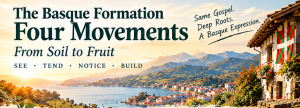
First we will read the soil together — looking honestly at what has depleted spiritual life in this culture and in our own histories. Not to assign blame, but to see clearly. You cannot tend what you haven’t honestly assessed.
Then we will tend the soil together — exploring what a shared Rule of Life might look like for this community. A simple set of rhythms built around three Basque-resonant anchors: Mahaia, the table; Hitza, the word; Bidea, the way. Not a law to perform but a shared texture of life — something humble enough to actually live, and deep enough to slowly form us into people from whom something real can grow.
Then we will learn to notice together — paying attention to where the Kingdom is already stirring in our existing relationships, and learning to recognize the people through whom it is most visibly moving. We will call these people Kingdom Catalysts. They are not necessarily the most gifted or experienced. They are people with what one practitioner beautifully calls holy imagination — people who can look through the keyhole of the present moment and glimpse the Kingdom possibilities on the other side.
And finally we will think together about structure — about what the lightest possible trellis looks like for a community beginning to grow. Not to centralize or control or replicate the very thing we are trying to move beyond. But to support what the Spirit is already doing, the way a trellis supports a vine — from underneath, invisibly, just enough.
What Success Looks Like
How the Framework Measures Fruitfulness
The framework refuses to measure success by the metrics most ministry frameworks use — attendance, conversions, church plants, organizational growth, budget expansion. These metrics are not only inadequate for the Basque context, they may be actively harmful — they create pressure toward the kind of scale and speed that depletes soil rather than restoring it.
In the earliest season
Success looks like a small community in Bergara or Getaria gathering regularly around a shared meal, practicing the rhythms of Mahaia, Hitza, and Bidea with increasing faithfulness, developing the eyes to notice where God’s fingerprints are already present in their existing relationships, and taking one specific, simple, small, slow step in response to what they are noticing. We call them Kingdom communities learning to follow and be like Jesus.
In the middle season
Success looks like the groups identify individuals from an existing Kingdom community to extend the invitation to people in their networks join them in following Jesus and walking in the light; to begin gathering, tending and growing a new Kingdom community around Jesus at a new table. We call this person(s) Kingdom Catalysts.
In the later season
Success looks like a network of genuinely Kingdom communities — indigenous in form, following Jesus, expressed in Euskara, led by Basque people, sustainable through Basque resources — connected to one another by a shared lightweight trellis and carrying the Kingdom into every corner of this extraordinary culture. The outside catalyst increasingly unnecessary.
At every season
Success looks like the Basque community becoming more itself as they reflect the way of Jesus through their cultural containers. More rooted in Jesus. More expressive of its own culture. More led by its own people. More sustainable through its own resources. More capable of leading its own movement without ongoing outside support.
CLOSING
This framework is not a finished document. It is an opening — an invitation to a conversation that must continue to be shaped by the Basque community itself as that community grows in its capacity to see its own terrain, recognize its own thin places, cross its own thresholds, and lead its own movement.
The outside catalysts who walk alongside that conversation are guests on the Camino — pilgrims whose presence is welcomed for a season, whose perspective is genuinely useful for a season, and whose greatest contribution to the Basque church is ultimately their willingness to decrease so that what is genuinely Basque can increase.
The framework will be revised. The sessions will be adapted. The practices will be corrected by the community’s own experience of what serves life in this specific soil.
What will not change — what the framework holds as non-negotiable across every revision and every season — is the conviction that the God whose fingerprints are already on the terrain of Euskal Herria is fully capable of bringing to completion what He has already begun here.
The oak doesn’t grow in a day. But it has begun to grow. And the soil that once looked like hard clay — that wouldn’t even break when you dropped it — is beginning, slowly, to turn dark and rich and alive in the hands of the Gardener who never stopped tending it.
Grace and grit to you as you build the trellis beneath the vine.
Raíces / Sustraiak / Roots · Living document, second iteration · Offered to the Basque church with open hands