Walking Together to Fulfill Both Commissions
JUL 21, 2026
Walking Together to Fulfill Both Commissions
For the Basque believer and the outside catalyst, walking the same five-stage road as co-laborers — making disciples of Jesus, and tending the culture he has given to flourish in him.
Matthew 28:18–20 · The Great Commission | Genesis 1:28 · The Cultural Mandate
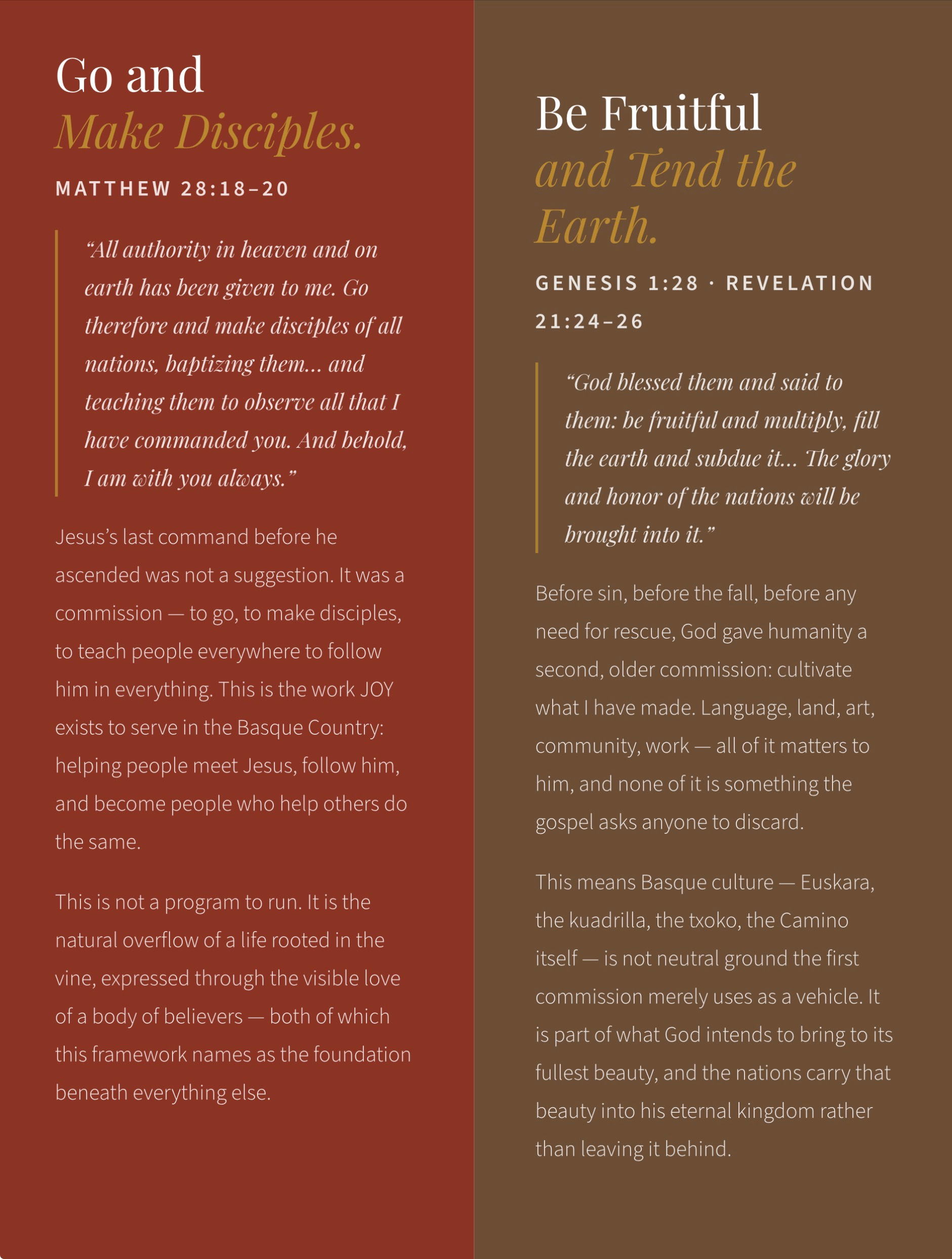
The First Commission: Go and Make Disciples
Matthew 28:18–20
“All authority in heaven and on earth has been given to me. Go therefore and make disciples of all nations, baptizing them… and teaching them to observe all that I have commanded you. And behold, I am with you always.”
Jesus’s last command before he ascended was not a suggestion. It was a commission — to go, to make disciples, to teach people everywhere to follow him in everything. This is the work JOY exists to serve in the Basque Country: helping people meet Jesus, follow him, and become people who help others do the same.
This is not a program to run. It is the natural overflow of a life rooted in the vine, expressed through the visible love of a body of believers — both of which this framework names as the foundation beneath everything else.
The Second Commission: Be Fruitful and Tend the Earth
Genesis 1:28 · Revelation 21:24–26
“God blessed them and said to them: be fruitful and multiply, fill the earth and subdue it… The glory and honor of the nations will be brought into it.”
Before sin, before the fall, before any need for rescue, God gave humanity a second, older commission: cultivate what I have made. Language, land, art, community, work — all of it matters to him, and none of it is something the gospel asks anyone to discard.
This means Basque culture — Euskara, the kuadrilla, the txoko, the Camino itself — is not neutral ground the first commission merely uses as a vehicle. It is part of what God intends to bring to its fullest beauty, and the nations carry that beauty into his eternal kingdom rather than leaving it behind.
How the Two Commissions Work as One Calling
Disciple-making that erases culture has failed the second commission. Cultural pride that resists Jesus has failed the first.
JOY does not treat these as competing priorities to balance against each other, or as two separate departments doing two separate jobs. They are one calling, held together. A Basque believer who follows Jesus and brings their whole Basque self into that following is fulfilling both commissions in a single life. An outside catalyst who makes disciples while genuinely tending — never replacing — the culture they have been sent to serve is doing the same.
The five stages of the Camino that follow are how this framework holds both commissions together in practice — for the catalyst and the Basque believer alike, walking side by side rather than one leading and one following.
The test for both commissions held rightly: Does the disciple-making happening here produce people who are more fully themselves — more fully Basque, more fully alive in their own language and land — or does it quietly ask them to become someone else in order to belong? If the second is happening, the first commission is being pursued at the expense of the second, and that is not the calling JOY exists to fulfill.
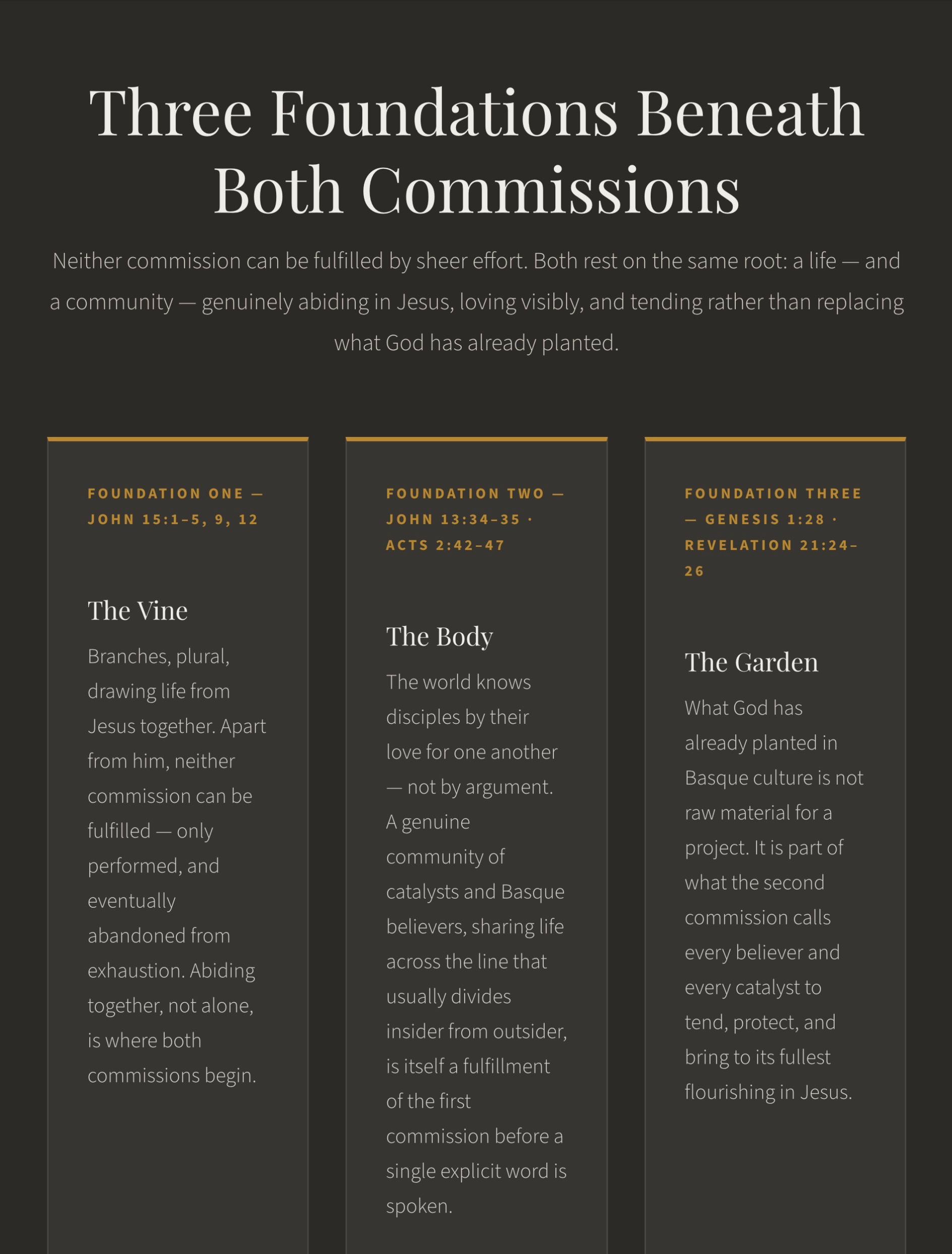
Three Foundations Beneath Both Commissions
Neither commission can be fulfilled by sheer effort. Both rest on the same root: a life — and a community —
genuinely abiding in Jesus, loving visibly, and tending rather than replacing what God has already planted.
How JOY names this practice
Jesus. Others. You.
JOY is the simple order both commissions are lived out in. Jesus first, because both commissions collapse without him — disciple-making becomes a program, and cultural stewardship becomes mere preservation. Others second, because both commissions are inherently relational — disciples are made among people, and culture is tended in community, never alone. You third, because a life and a community rightly ordered around Jesus and others is the only kind that actually bears fruit rather than burning out chasing fruit it was never designed to produce solo.
This order belongs equally to the catalyst and the Basque believer. Neither is exempt from it. Neither fulfills it alone.
Two People. One Road. One Calling.
This framework is written to be walked by two people together: a Basque believer, who carries language, history, and belonging that no outsider can replicate, and an outside catalyst, sent by JOY, who carries distance, resourcing, and the particular gifts of someone who has chosen this place rather than been born into it. Neither role is higher. Both are necessary. Both are accountable to the same five stages, and both are fulfilling both commissions in every stage they walk
The Basque Believer Brings
Language, kuadrilla, txoko, land, generational presence, and the credibility that only comes from belonging to this place for a lifetime. They are the primary disciple-maker and the primary steward of their own culture.
The Outside Catalyst Brings
Distance that can sometimes see clearly, resourcing, intercession, encouragement, and a willingness to learn, serve, and stay behind — never ahead — of the Basque believers they walk alongside.
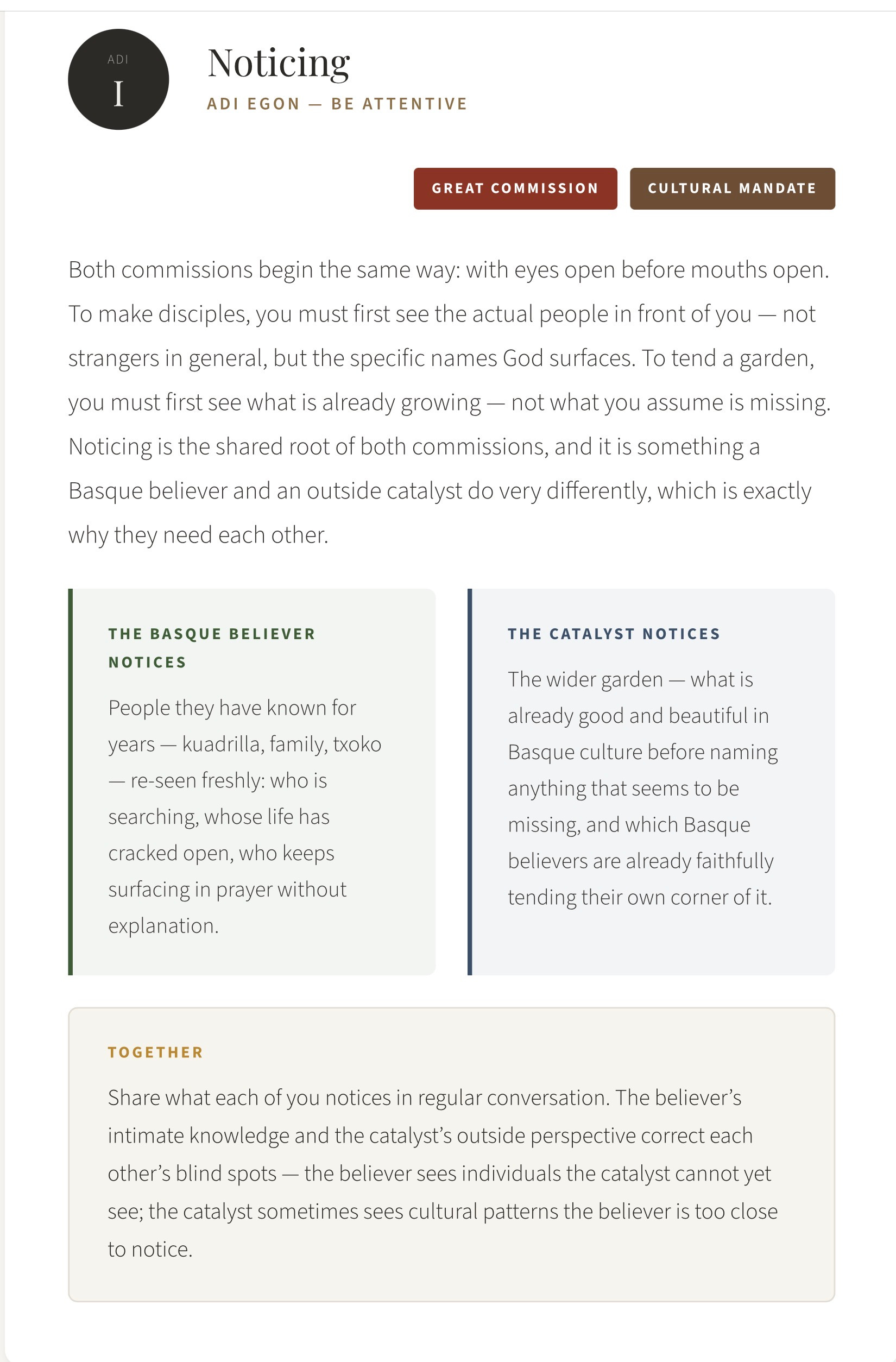
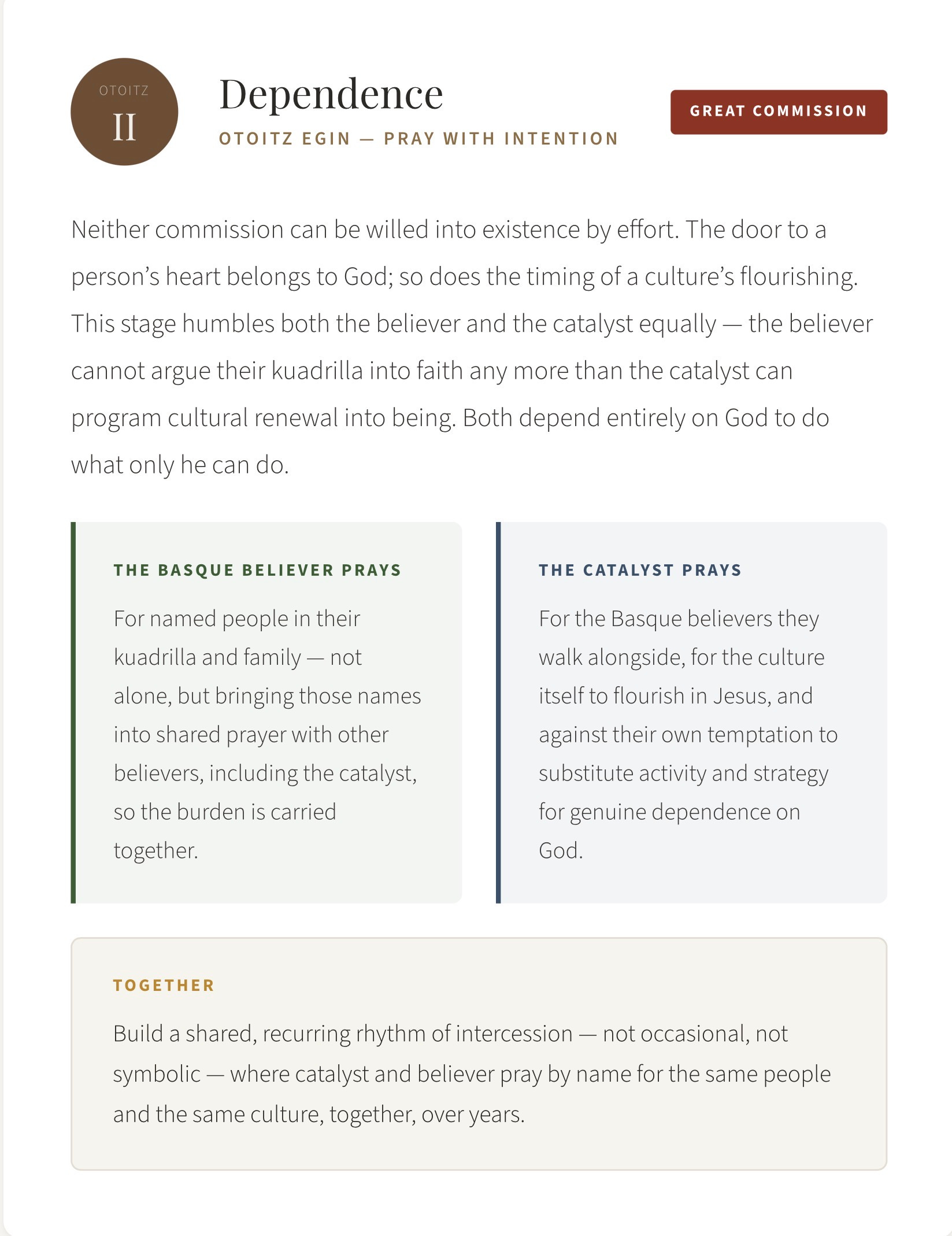
What follows describes each of the five stages from both vantage points side by side, and names, at the end of each stage, what the two of them do together — because both commissions are fulfilled most fully when both people are present, honest, and walking at the same pace.
The JOY Camino
Colossians 4:2–6 · Five stages, two commissions, two people
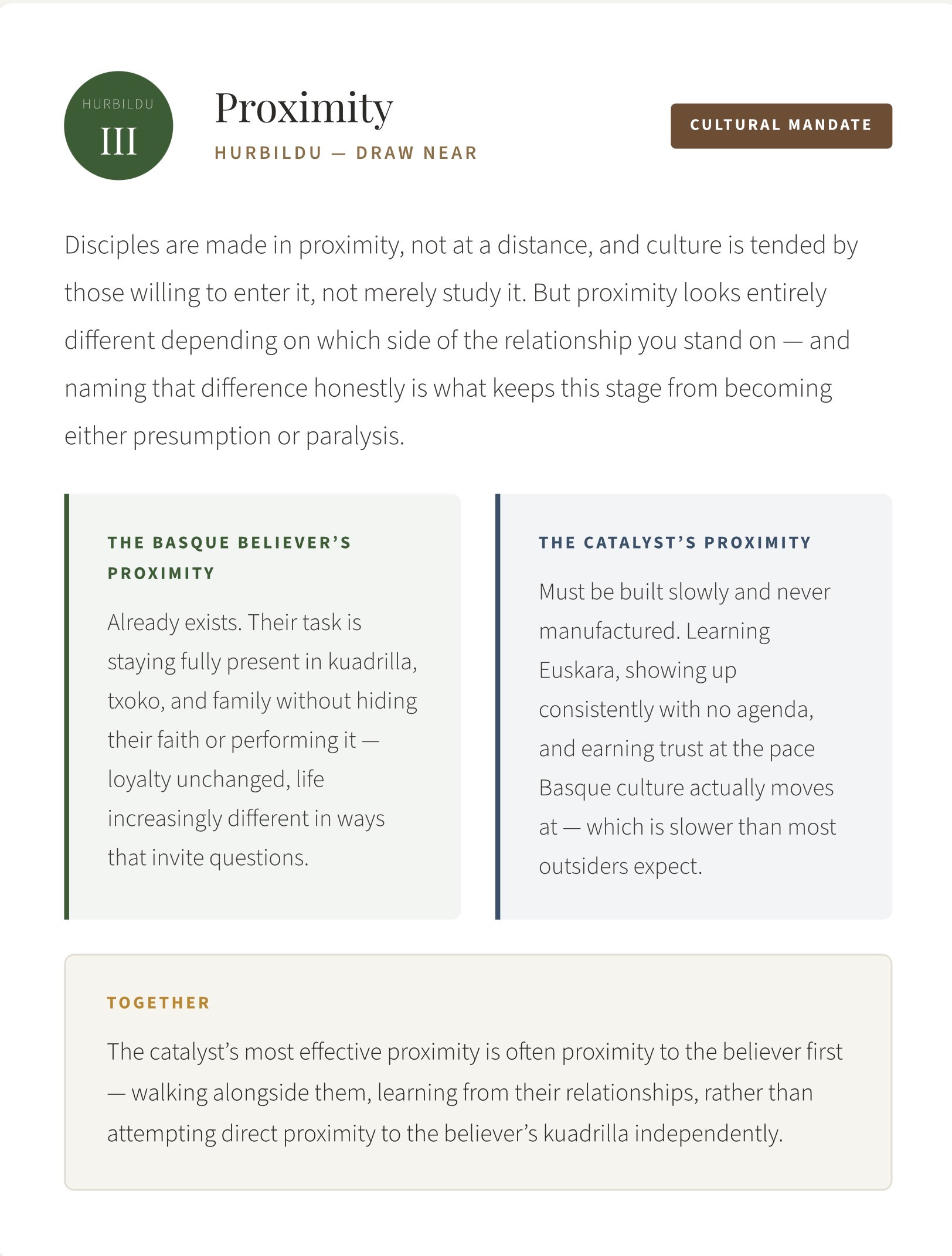
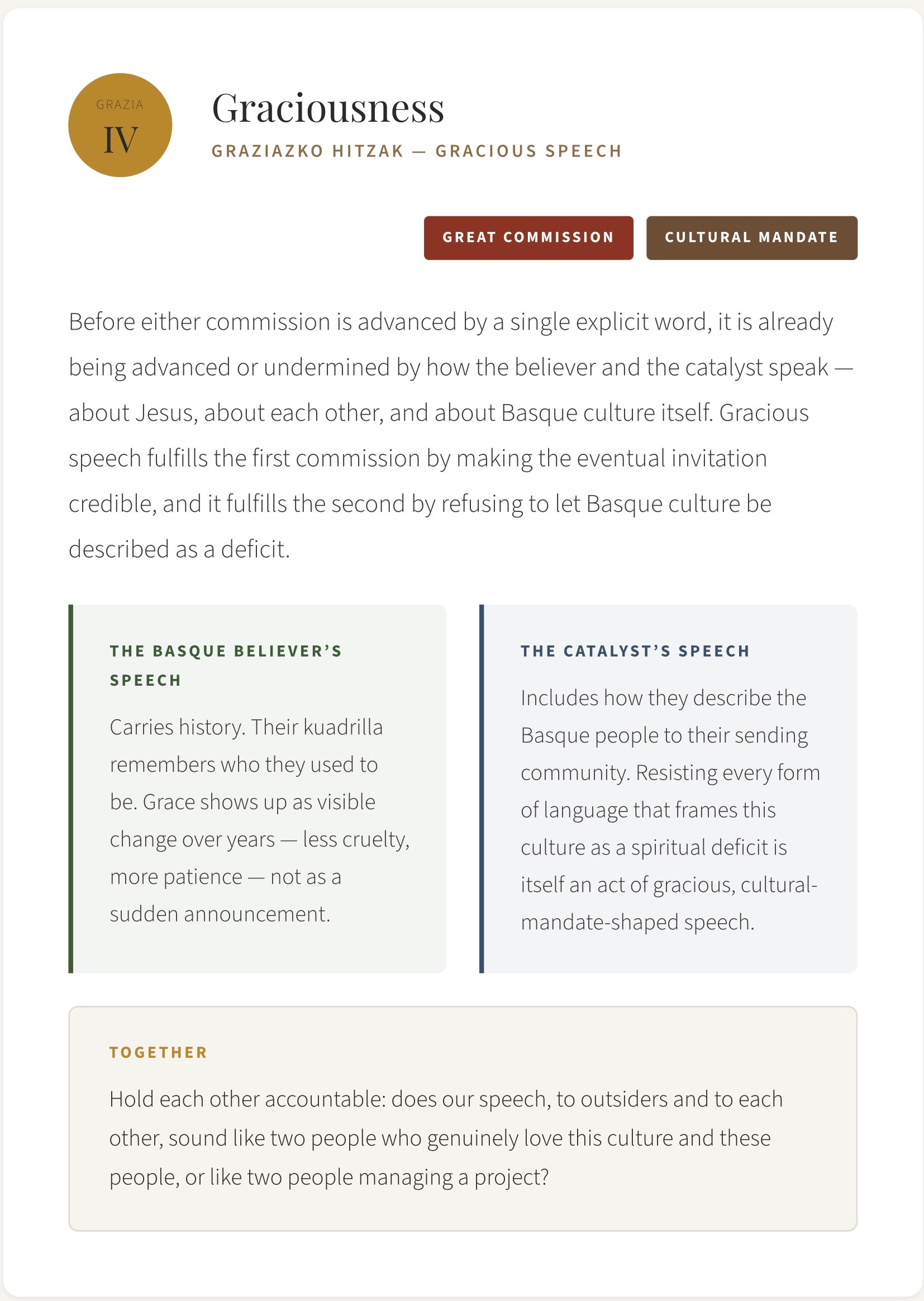
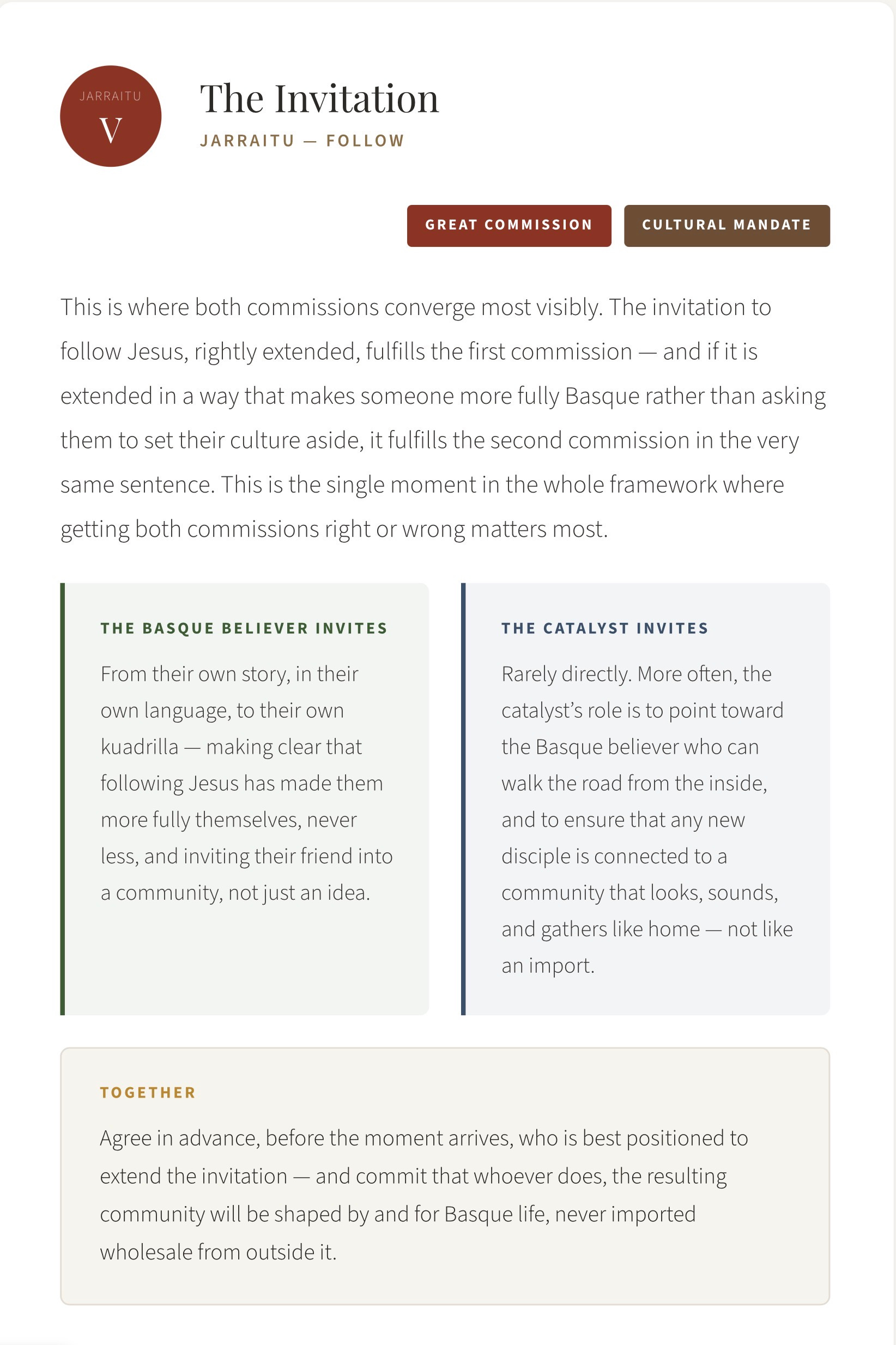
Each stage carries a tag showing which commission it most directly serves — though in truth, every stage serves both. Disciple-making and cultural stewardship are never fully separable in a life rightly ordered around Jesus and others.
FOR JOY STAFF OVERSEEING THIS CAMINO
Holding Both Commissions in Every Pairing
JOY’s task is not to choose between disciple-making and cultural stewardship, or to assign one to catalysts and the other to believers. It is to ensure every catalyst-believer pairing is pursuing both, together, at every stage.