
Becoming the Kind of Person the Basque People Can Trust
Series: The Formation of the Catalyst — Post 1 of 7
Mar 29, 2026
Why the most dangerous practitioner in the Basque context is the well-intentioned but unformed one — and what formation actually means
Introduction
The first series in this publication, Zurekin Egon Da Beti, drew on more than thirty years of JOY Ministries’ experience in the Basque Country to establish a simple but demanding conviction:
God has never been absent from the Basque people.
Long before any missionary arrived, the Spirit was already present. The wounds of history, the endurance of Euskara, the rhythms of the kuadrilla, the hospitality of the table, the longing carried through art, pilgrimage, and memory—these are not evidence of God’s absence but signs that He has continued to work in ways that often escaped the notice of those who came looking for something else.
That series explored the theological landscape of Gospel witness in the Basque Country. It examined the historical wound left by the institutional church, distinguished the Jesus of the Gospels from the Christ often associated with political power, explored communal rather than individual patterns of conversion, and argued that the Gospel naturally takes root through indigenous cultural forms rather than imported ecclesial structures.
If that theological vision is true, it carries an unavoidable implication.
The primary question is no longer:
How do we bring the Gospel to the Basque people?
The question becomes:
What kind of person is capable of recognizing what God is already doing?
That question is the subject of this series.
It begins with a story.
A missionary spent twenty-three years in the Basque Country and never once crossed the threshold of a Basque home.
He was not a bad man. He was not a careless missionary. By every available measure he was faithful—present for more than two decades when the work was difficult, the visible fruit was sparse, and the institutional church had given many Basques every reason to distrust anyone connected with Christianity.
Twenty-three years of showing up is not nothing.
In most places, it would be everything.
In this context, it was not enough.
The reason it was not enough reveals something essential about the Basque Country—and about the kind of person this context requires.
The problem was not strategy.
It was not programs.
It was not theology, at least not directly.
It was formation.
The practitioner who cannot cross the threshold of a Basque home after twenty-three years has not primarily lacked perseverance. They have lacked the kind of formation that enables them to perceive another people without first filtering them through their own assumptions.
This is where the conversation must begin.
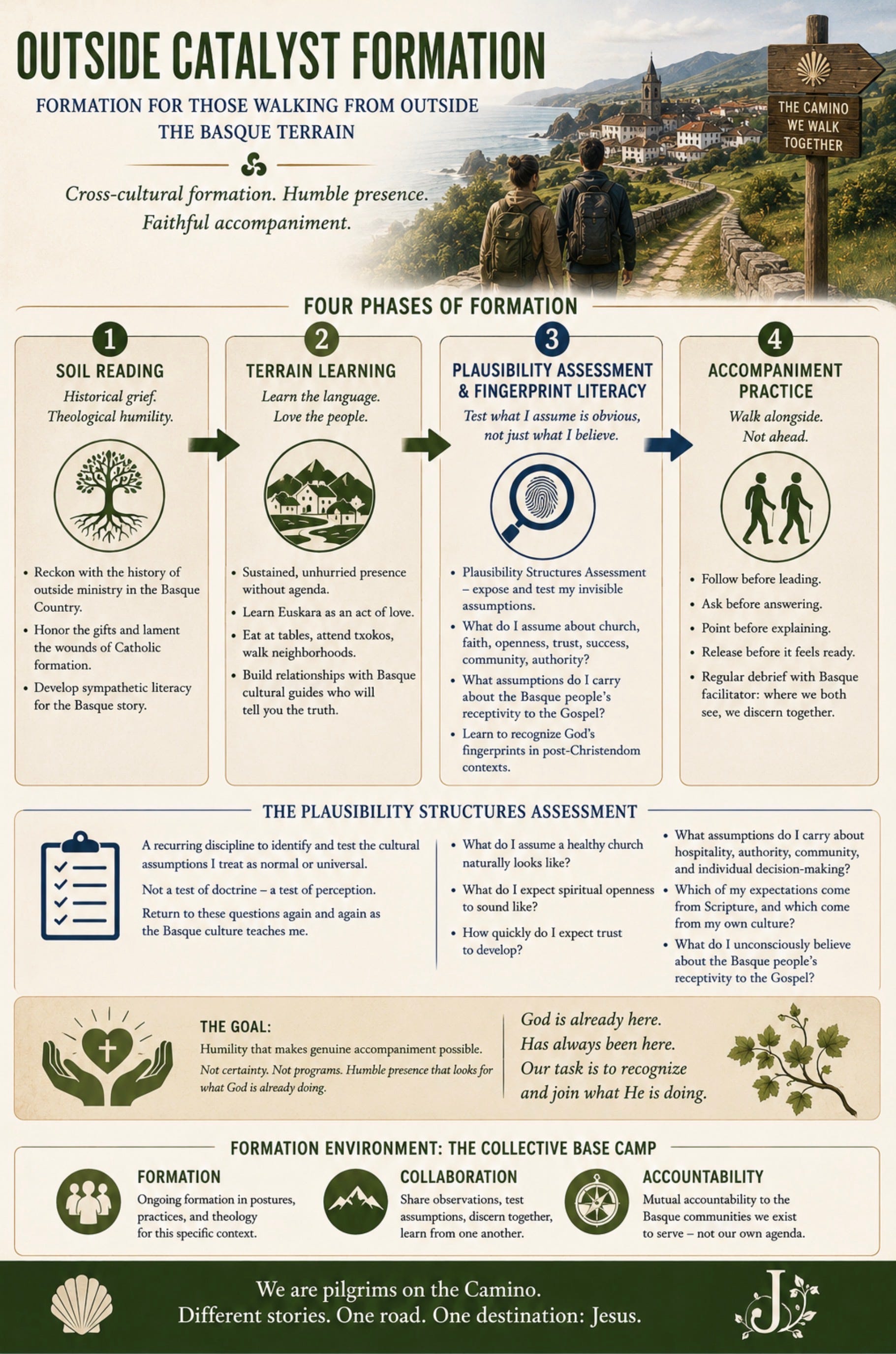
Every catalyst carries what sociologists call a plausibility structure—a network of assumptions about what is normal, what is obvious, what church should look like, how trust develops, what spiritual openness sounds like, and how people ordinarily come to faith. Most of these assumptions are not consciously chosen. They are inherited from one’s own culture, church tradition, and ministry experience. Because they feel self-evident, they often remain invisible.
The Basque Country exposes those assumptions.
The first work of formation is therefore not learning the Basque people. It is learning to see the lenses through which we have always viewed them.
Only then can history become grief rather than information.
Only then can ethnography become theological listening rather than cultural observation.
Only then can Euskara become an act of love rather than a communication strategy.
Only then can friendship become genuine rather than instrumental.
This is why the practitioner in this series is called a catalyst.
A catalyst does not create the reaction. It creates the conditions in which a reaction already waiting to happen can proceed. It enables life without becoming the center of it. And when the reaction begins, the catalyst steps back.
That image captures the vocation of Gospel witness in the Basque Country.
The catalyst does not bring God to this people.
God is already here.
The catalyst learns to recognize His fingerprints, to accompany what He is already growing, and to help remove the obstacles that keep others from seeing Him.
This makes a demanding claim.
Before the catalyst can faithfully participate in what God is doing in the Basque Country, they must themselves be transformed.
Formation is not preparation for mission.
Formation is the first expression of mission.
What this series explores is not primarily what the catalyst must do for the Basque people.
It is what the Basque people—and the Spirit already at work among them—must be allowed to do to the catalyst.
The movements that follow d
escribe that journey: from emptying inherited assumptions, to entering the Basque story with grief, to learning to recognize God’s fingerprints in this particular soil, and finally to becoming the kind of companion whose presence itself makes trust possible.
Next in the series: The Conversation We Couldn’t Have – You will be transferred to the Joy Ministries Substack site.