
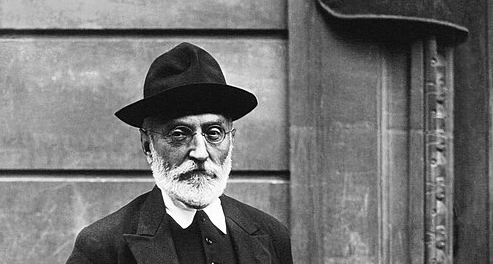
Unamuno and the Basque Soul
I. How to Read Unamuno: The Hebrew Lens
Before entering Unamuno’s thought, one clarification is necessary—because the most common misunderstanding happens not in the reading, but in the lens we bring to it.
Much of American Christianity has been shaped by Greco-Roman philosophical categories. Truth is primarily propositional. Theology aims at systematic coherence. Contradictions are problems to be solved. Faith is expected to resolve doubt. Emotional certainty is often treated as a sign of spiritual health.
Within that framework, Unamuno appears unstable. He refuses neat resolution. He lives in tension. He allows doubt to coexist with belief. He speaks of faith as struggle rather than as settled clarity.
But this reaction reveals more about the lens than about the man.
Unamuno is not operating in Greek metaphysical categories. He is far closer to the Hebrew world of Scripture—a world where relationship precedes system, where lament is holy, and where wrestling with God is not rebellion but covenantal engagement.
In the Hebrew framework:
- Abraham argues with God.
- Jacob wrestles with God and limps away blessed.
- Job protests and questions.
- The Psalms cry out in confusion and despair.
- Even Christ prays in anguish: “Why have you forsaken me?”
None of these moments represent theological failure. They represent relational fidelity within tension.
If we read him through a Greco-Roman grid, we may conclude that he lacks doctrinal clarity. But if we read him through a Hebrew relational lens, we see something different: a man preserving the dignity of the human soul that refuses annihilation and insists on addressing God—even amid doubt.
This does not mean abandoning objective truth. The Hebrew framework maintains that God exists independently of our perception. But it allows lived experience—anguish, silence, longing—to coexist with that objective reality without collapsing faith into either cold abstraction or emotional triumphalism.
Unamuno is not Job’s opposite. He is Job’s heir. Read him from within the world he inhabits—closer to Gethsemane than to scholastic precision—and his “tragic sense of life” is not theological instability. It is existential faithfulness.
II. The Man and His World
Miguel de Unamuno (1864–1936) is one of the most important thinkers to come out of Spain, yet his heart and imagination were unmistakably Basque. Born in Bilbao, raised among the tight-knit cuadrillas and ancient rhythms of Basque life, Unamuno carried his homeland’s questions into everything he wrote: What does it mean to belong? What gives life meaning? How do we face suffering and death with honesty and hope?
For American evangelicals trying to understand Basque culture, Unamuno is a surprisingly helpful guide. He gives language to the spiritual instincts Basques already live out—instincts that don’t always look “religious” in a churchy sense, but run deep beneath the surface of their communal life.
His 1913 work, The Tragic Sense of Life, presents a profound meditation on the human condition: the tension between reason, mortality, and the longing for something more. At the center of his thought is what he calls “the man of flesh and bone”—the concrete individual who experiences life, death, and spiritual hunger intimately. Unlike philosophical systems that prioritize abstract reasoning, Unamuno insists on existential urgency: humans cannot escape the awareness of mortality, and this awareness generates an irreducible desire for eternal life.
III. The Tragic Sense of Life
At the heart of Unamuno’s philosophy is the tragic sense of life: the permanent tension between reason, which doubts immortality, and desire, which demands it. He believed that every human being carries a longing for something more than this world can offer—a longing for permanence, for love that doesn’t end, for life beyond death.
Rather than seeing this tension as a weakness or a problem to be solved, Unamuno saw it as the most honest part of being human. Faith, for him, is not a matter of intellectual certainty but a willful, passionate affirmation in the face of doubt. Doubt is constitutive rather than destructive; spiritual maturity emerges from struggle, not serenity. Christ’s agony in Gethsemane, Job’s wrestling with God, and the laments of the Psalms exemplify this agonistic approach to faith.
Unamuno’s existential honesty, however, leaves a gap if taken alone. While he argues that human longing points inevitably toward the need for a personal, infinite God, he provides no rational or historical proof of such a being. Faith becomes heroic but potentially self-referential—reliant on the intensity of experience rather than on objective reality. Prayer into silence may produce emptiness, and the risk of collapsing faith into self-projection is real.
This is where the Hebrew relational framework becomes essential. It grounds Unamuno’s existential insight in objective reality: God exists independently of human perception or need. Humans are made in His image, and faith is relational—it persists even amid doubt, silence, or suffering. Silence, in this framework, is relational tension, not evidence of absence. Human longing retains directionality and meaning without collapsing into arbitrariness.
The soul’s hunger is neither arbitrary nor despairing; it becomes a compass pointing toward the personal infinite God—the only being capable of truly satisfying the human longing for eternal life.
IV. The Cuadrilla: Where the Tragic Sense Is Lived
Unamuno’s reflections on Basque identity often center on the cuadrilla—the close-knit social groups that have historically organized Basque life. For Unamuno, the cuadrilla was more than a social convenience; it was an existential expression of solidarity, identity, and mutual affirmation.
This is where his philosophy becomes most directly useful for understanding Basque people today. The longing he describes isn’t only individual. It’s communal. It’s something a cuadrilla feels together as they share meals, walk the same streets, celebrate festivals, and carry one another through suffering. The traditions, loyalty, and shared experiences of these communities are not just cultural habits—they are a concrete manifestation of relational and moral reality.
Within the tragic sense of life, individual anguish and longing are tempered and shared through communal bonds. The existential struggle is personal, but it is never faced alone. Unamuno understood that humans are wired for connection—that struggle is both individual and communal, and that the cuadrilla provides proximate support and orientation, helping individuals sustain their courage amid mortality and doubt.
This integration of the existential, the relational, and the communal is Unamuno’s most holistic insight: the human soul longs for eternity, engages in dialogue with God, and persists within social solidarity. Together, these layers provide a richer foundation for authentic and sustainable living amid the tragic sense of life.
V. What This Means for Evangelicals Among the Basques
Unamuno did not come to faith through systematic theology or institutional religion. He came through longing—through the ache for eternal life that he believed Christ alone fulfills. In this way, he mirrors the spiritual journey many Basques might take today: not starting with propositions, but with desire; not with arguments, but with the shared human experience of suffering, hope, and the search for meaning.
He shows that the deepest spiritual questions aren’t always asked in sermons or Bible studies. Sometimes they’re asked around a table, in a story, in a moment of silence, or in the fierce loyalty of friends who refuse to abandon one another. He helps us see that God often works through the ordinary bonds of community long before anyone is ready to talk about doctrine.
For American evangelicals, Unamuno offers a bridge. He helps us understand why Basques value community so deeply, why they resist religious pressure, and why spiritual conversations must grow slowly, relationally, and authentically. He reminds us that the gospel often enters a culture not by force, but by presence—by walking with people in their questions, honoring their stories, and revealing Christ as the One who meets the deepest longings of the human heart.
The tragic sense of life does not require the elimination of doubt, silence, or anguish. Instead, it invites the human soul into a disciplined, honest engagement with mortality, relational longing, and the ultimate reality of God. By synthesizing Unamuno’s existential honesty, the Hebrew grounding of faith, and the stabilizing influence of communal structures like the cuadrilla, we find a framework where struggle is dignified, relational faith is both authentic and stable, and the soul’s hunger is not despairing.