
War, Betrayal, Witchcraft, and the Fractured Community
Two Generals, One Embrace
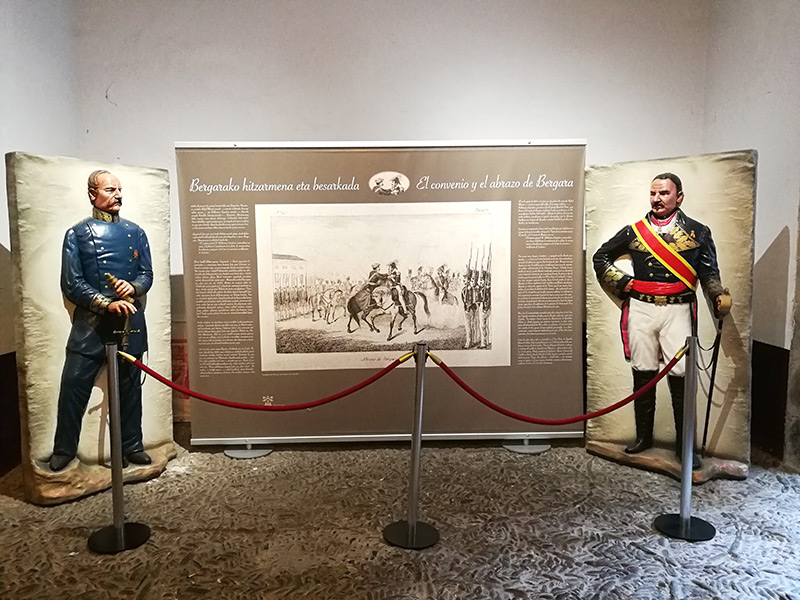
August 31, 1839. On a hillside outside Bergara, two generals rode toward each other — men who had been trying to kill each other for years. The Convention of Vergara, signed between Carlist General Rafael Maroto and liberal General Baldomero Espartero, terminated the First Carlist War in the Basque Provinces. They dismounted. They embraced. The war — for a moment — was over.
Espartero’s success at the negotiation earned him the popular title ‘Peacemaker of Spain.’ The Abrazo de Bergara — the Embrace of Vergara — became one of the most iconic images in Spanish political history. But the peace did not hold. The Navarrese battalions felt repugnance and distrust, and some officials still intended revolt. Two more Carlist Wars would follow. The embrace was real, but the wounds beneath it were not healed.
From 1793 onward, three successive wars engulfed the region. Bergara’s strategic location made it a preferred point for armies. The municipality was forced to privatize public lands. The community was stripped of its sons, its economy, and its trust.
The Shadow of the Witch Trials
But the deepest collective wound predates the Carlist Wars by two centuries. In January 1609, the largest witch trial in European history began in the Basque Country. By its end, some 7,000 cases had been examined by the Spanish Inquisition. The main figures were the sorginak — the ritual attendants of the goddess Mari — practitioners of the ancient Basque spiritual tradition that had survived beneath a veneer of Catholicism.
Most devastatingly, the majority of the nearly 2,000 who confessed were children aged 7 to 14. The community — neighbours accusing neighbours, children naming parents — was shattered at the root. The Inquisitor who eventually ended the trials, Alonso de Salazar Frías, concluded after 18 months of investigation that the majority of the accusations were false. He believed it was the priests’ own sermons on witchcraft that had created the panic — and that the best remedy was to stop speaking of it entirely.
He was a lone voice of reason within a system of terror. His courage ended the trials — but could not heal the wounds they left. For subsequent generations, ‘Christianity’ and ‘the Church’ were not words of comfort. They were words associated with coercion, denunciation, and the screams of children.
The Dominicans and the Shell of Religion
After the Second Carlist War, teaching at the Bergara Seminary was abandoned. The building was ceded to the Dominican Friars in 1880 on condition that they re-establish a teaching institution. They did so with distinction, restoring Bergara’s reputation for education and reviving the town’s cultural life. But the Dominicans also represent a pattern that would define Basque Catholicism for generations: the Church as institution rather than living community, maintaining form and structure while the transforming fire of the Spirit quietly dimmed. From the 1600s to the 1970s, the Basque people were known as devout Catholics with deep Marian devotion — yet beneath the religious surface, an equally strong tie to their pre-Christian roots remained unbroken.
Arantzazu: Three Fires, Three Rebirths
The sanctuary of Arantzazu, so close to Bergara’s world, suffered its own pattern of destruction and renewal. It survived three devastating fires — in 1553, 1622, and 1834 — and was rebuilt three times. Each fire mirrors the waves of war and destruction visited on the Basque people. Each rebuilding reflects their refusal to let the sacred be permanently extinguished.
Arantzazu became, through all of this, something more than a pilgrimage site. It became a symbol of survival — the sacred place that burned and rose again, again and again, just as the Basque people themselves burned and rose. One writer described it as the authentic personification of the spirit of the Basques: hard to get to, like the Basques themselves — hard to approach, hard to know, but once reached, profoundly moving.
Ignatius: The Wound That Opened a Door
Here, in a part about wounds, Ignatius of Loyola becomes the most important figure of all. His conversion was not a polite spiritual awakening in a comfortable chapel. It began with a cannonball.
During his long convalescence at the castle of Loyola — the shattered leg re-broken and reset so he could wear his courtly boots again — Ignatius endured months of enforced stillness. His wound was not just physical. Every ambition he had built his identity upon had been destroyed in a single moment at Pamplona. The soldier was finished. The courtier was finished. The Basque nobleman’s dream of glory lay in ruins.
It was in that ruin that God spoke. And on his way out of that season — healed, changed, surrendered — Ignatius stopped at Arantzazu and spent the night in prayer. The wounded knight, standing before the Lady of the Thorns, at the place whose very name proclaimed the holy in the middle of pain.
The cannonball that shattered Ignatius became the doorway through which Christ entered. Bergara’s communal wounds — war, the Inquisition, betrayal, witchcraft trials — are not obstacles to the gospel. In the hands of God, they are the very openings through which healing and new life can pour.
Spiritual Wounds — Part 3
⚔ The Wound of Political Fracture and Betrayal
Generations of civil war and the Church’s alignment with oppressive political power left a community unable to easily trust authority — including God’s. Healing requires honest acknowledgment of the Church’s failures and a demonstration of radically different authority: servant leadership, like Christ’s.
⚔ The Wound of the Imperfect Embrace
Maroto and Espartero’s embrace is a haunting image — peace attempted, not completed. Bergara carries in its communal memory the longing for reconciliation that never fully arrived. The gospel names this longing and fulfils it: Christ is the one who crosses no-man’s-land not on horseback but on a cross.
⚔ The Wound of Religious Terror
The Inquisition used the name of Christ to coerce children and destroy communities. For subsequent generations, ‘Christian’ became synonymous with ‘oppressor.’ This must be acknowledged honestly and without defensiveness before the gospel can be heard as good news.
⚔ Generational Trauma and Communal Betrayal
When neighbours accuse neighbours and children name parents, trust is shattered at the root. The gospel creates communities of radical trust and belonging — the koinonia of Acts 2 — which is the direct antidote to this wound.
✦ Gospel Bridge: Ephesians 2:14 — ‘For he himself is our peace, who has made the two groups one and has destroyed the barrier, the dividing wall of hostility.’ Bergara already knows what an embrace between enemies looks like. The gospel invites the town to discover the One who makes that embrace permanent — and who meets us precisely in our places of deepest wounding.