
Secularism, Hunger, and the Open Door
The Collapse of a World
Something remarkable happened in Bergara — and across the Basque Country — in the last decades of the twentieth century. A society that had been Catholic for centuries simply stopped. Within a few decades, church attendance dropped more than 80%. Not gradually — precipitously. Within a single generation, the rhythms of Mass, confession, and religious festival that had organised social life for centuries evaporated.
This was not simply secularisation. It was the collapse of a system that had never fully taken root. When the cultural pressure to be Catholic lifted — when Franco’s regime ended and the modern world rushed in — there was nothing beneath the surface strong enough to hold people. Most Basques still claim Catholicism as a cultural identity, but real allegiance to the Church has been greatly weakened. The Church’s emphasis on biblical teaching rather than tradition is very weak. The shell cracked, and people walked out into the open air, blinking.
The Return to the Old Ways
Into this vacuum, something ancient is stirring. As people move away from institutional Catholicism, some are beginning to reconnect with the pre-Christian Old Religion. The goddess Mari — long dormant beneath a Catholic surface — is finding new devotees. Neo-paganism, nature spirituality, and a romanticised return to pre-Christian Basque identity are growing, especially among the young.
The Basques are a proud people — proud of their history, culture, and standing in the world. But as they reconnect with their pagan past, many of those influences are not spiritually healthy. The Basques need a constructive identity — one that honours their uniqueness without leading them back into the spiritual covenants that damaged their ancestors.
The Industrial and Post-Industrial Soul
The market, the manufacture of weapons, and the iron workshops made Bergara develop economically and socially. During the 19th century, textile and metallurgical industries transformed the town. In 1888 the arrival of the railway connected Bergara with the major centres of Euskadi. Industrialisation brought prosperity — and uprooted traditional community, accelerating the anonymity of modern life. The factory floor replaced the parish courtyard. The gospel creates community, the belonging that the industrial economy and the smartphone cannot provide.
What the Sacred Landmarks Are Saying
Looking across the full landscape of Bergara’s spiritual history, two sacred places stand out — and both are speaking to this moment.
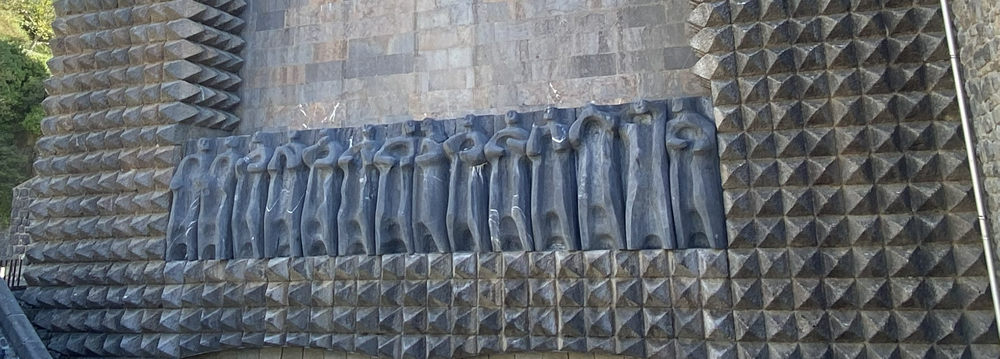
Arantzazu still draws pilgrims. But many come seeking Basque identity more than Christ — cultural memory more than living encounter. The sanctuary is full of the question the shepherd Rodrigo asked in 1468: “You, in the thorns?!” — but in the post-Christian era, fewer people are waiting for an answer. The sanctuary has become a symbol of Basque survival rather than a doorway to personal transformation.
Yet the question remains inscribed in stone. And the Ignatian Way — the ancient pilgrimage route from Loyola to Manresa that passes directly through Bergara’s region — still brings walkers through this landscape every year, tracing the footsteps of the wounded Basque knight who found God not in triumph but in the rubble of his ambitions.
The Ignatian Way passes through Bergara’s world. Every pilgrim who walks from Loyola to Arantzazu is unconsciously re-enacting the story of a wound that became a doorway, of a proud Basque life that was broken open to receive something greater than itself. This route is itself a gospel proclamation written into the geography of the land.
What Bergara’s People Are Still Teaching Us
Looking back across the figures who shaped Bergara, a pattern of gospel hope emerges:
| Person / Place | What They Offer the Gospel |
| Ignatius of Loyola | The Basque cannonball story: a proud, wounded man broken open to God. Proof that Basque identity and Christian transformation are not opposites. |
| Arantzazu | A 550-year-old question embedded in the landscape: ‘You, in the thorns?’ — pointing unmistakably to the cross. |
| Count of Peñaflorida | Proof that faith and intellectual life can be held together with integrity. Model for gospel witness in an educated culture. |
| Elhuyar Brothers | God-given curiosity that stops short of the Source. An invitation to let discovery lead all the way to the Discoverer. |
| Moguel | Language as the vessel of the soul. The gospel must come in Basque — in the heart language of the people. |
| Maroto & Espartero | An embrace between enemies: the image Bergara already carries. The gospel offers the peace that makes it permanent. |
| Arantzazu’s Three Fires | Destruction and rebirth, again and again. The Spirit of the risen Christ is the ultimate fulfilment of this pattern. |
Spiritual Wounds — Part 4
⚔ The Post-Christian Void
The 80% collapse of church attendance is not merely a statistic — it is a spiritual emergency and an opportunity. A people who have lost their religious home are, often without knowing it, searching. The gospel meets seekers.
⚔ The Lure of Neo-Paganism
The return to Mari and the old ways is a profound spiritual hunger for the sacred, natural, and communal — all of which the institutional Church failed to provide. The gospel offers what the old gods promised but could not deliver: real presence, real belonging, real transformation.
⚔ Identity Without Transcendence
Basque cultural pride is a gift, but when it becomes the ultimate reference point, it cannot bear the weight. Christ offers what culture alone never can: an identity that is both rooted and eternal.
✦ Gospel Bridge: John 4 — the woman at the well. She had tried every available source of meaning and come up empty. Jesus did not shame her for her searching; he named her thirst and offered himself as the water she had always needed. Bergara is that woman — ancient, proud, searching, and thirsty. And the One who stands at the well already knows her name.