
Origins, Identity, and the Basque Spirit
A Town Born at the Crossroads
Bergara did not happen by accident. Founded on July 30, 1268 by Alfonso X at a place called Ariznoa — at an important point on the Camino Real connecting Vitoria with the ports of Deba and Mutriku — it was from the first a place of meeting: merchants, pilgrims, armies, and ideas converging in a mountain valley at the heart of Gipuzkoa. Geography shaped destiny.
The People Who Cannot Be Explained
To understand Bergara, you must first understand the Basques. Their language, Euskara, is a linguistic mystery with no clear relationship to any other language in the world. They call themselves euskaldun — Basque speaker — and their country Euskal Herria, the Country of the Basque Language. In terms of physical features, archaeology, and their ancient tongue, they are clearly a people apart: never conquered by the Visigoths, never subdued by the Moors, always resisting external domination. To be Basque is to carry something ancient and undefeated in your bones.
Beneath this fierce identity lay a spiritual world older than Christianity. Pre-Christian belief centred on a goddess called Mari, with numerous place-names containing her name suggesting sites of her worship. Mari’s consort, Sugaar, appears as a man or a serpent-dragon. Together this chthonic couple was said to hold the power of creation, destruction, and supreme ethical authority. The Basques were the last population in Western Europe to be converted to Christianity, and even by 1600 the area was not strongly Christian.
Arantzazu: The Holy in the Thorns
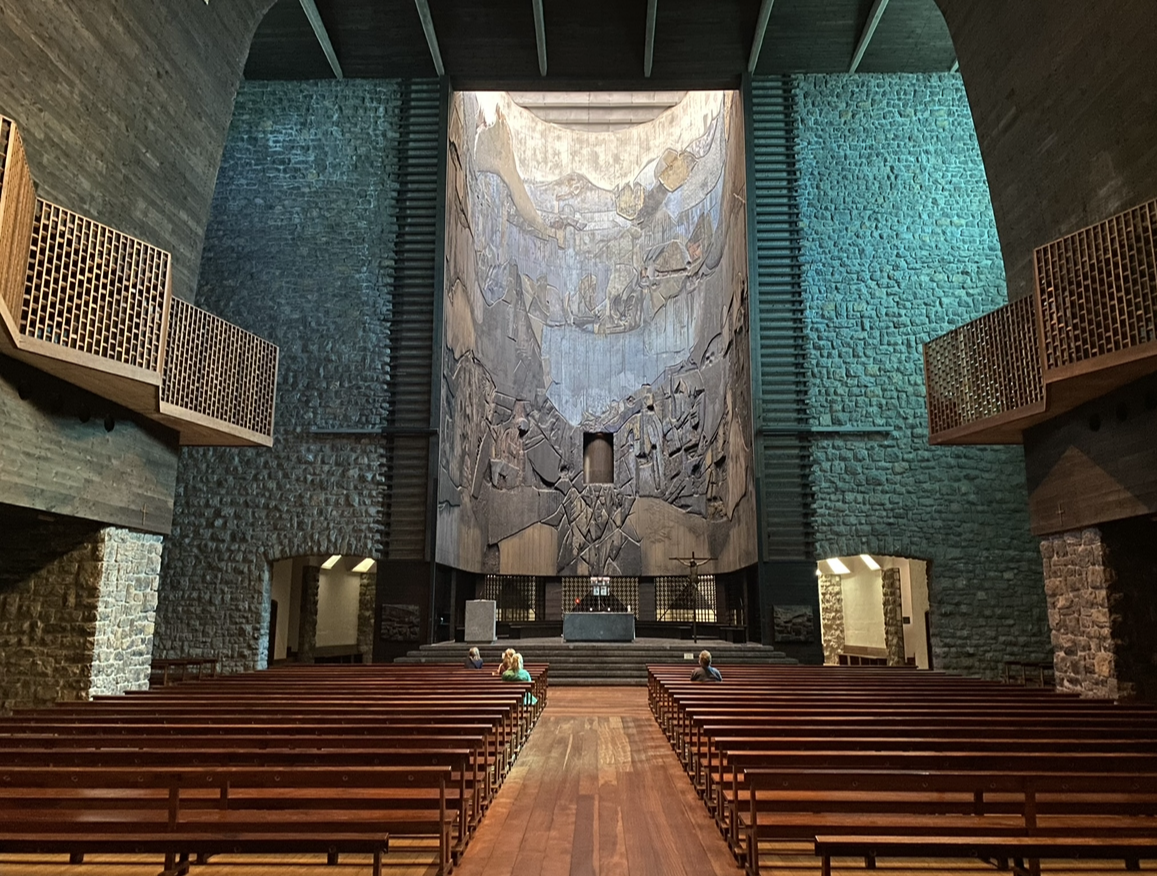
Just a short mountain journey from Bergara, in the highlands above the neighboring town of Oñati, a shepherd named Rodrigo de Balanzategui was tending his flock in 1468 when he found a small carved image of the Virgin in a hawthorn bush. His startled cry — “Arantzan zu?!” — “You, in the thorns?!” — gave the place its name forever. Arantzazu: the place of the thorns, the place of the sacred surprise.
This sanctuary sits just over the ridge from Bergara’s world. The Virgin of Arantzazu became the patron of the whole province of Gipuzkoa. For the people of Bergara, Arantzazu was not distant or foreign — it was the spiritual heartbeat of their mountain landscape, the place their grandmothers went when they needed to pray. It appeared during dark and bellicose times for the Basques, and devotion to the Lady of the Thorns deepened among the people and nobles of Gipuzkoa precisely during the wars and instability of that era.
The name is already a prophecy. The holy One, found not on a throne but in the thorns — this is the gospel in six words. The shepherd’s startled cry of 1468 is an unconscious anticipation of the cross itself.
Juan Antonio Moguel: The Man Who Wept Over a Language
No figure better captures the Basque love of identity than Juan Antonio Moguel (1745–1804), teacher at the Bergara Seminary and author of Peru Abarka. He is remembered as the first great defender of the Basque language in the region — moved to grief by hearing children translating Basque into Spanish as if their mother tongue were something to be ashamed of.
Moguel’s tears were prophetic. For him the Euskara tongue was the vessel of a people’s soul. Lose the language and you lose something irreplaceable about who God made the Basques to be. His passion points to a deep principle for gospel mission: people receive truth most deeply in the language they dream in.
Ignatius of Loyola: The Basque Who Changed the World
Barely thirty miles from Bergara, in the green Urola valley of Azpeitia, a boy named Íñigo López de Oñaz y Loyola was born in 1491. He would become the most spiritually influential Basque who ever lived — Saint Ignatius of Loyola, founder of the Society of Jesus.
He was Bergara’s neighbour: same province, same mountains, same Basque blood and culture. His parents were of the minor nobility, entangled in the fierce Basque clan wars of the era. Young Íñigo grew up steeped in the warrior code of honour, ambition, and pride that shaped every Basque nobleman — the same cultural soil in which Bergara was rooted.
Ignatius is not peripheral to this story. He is its greatest native witness: proof that a proud, wounded, ambitious Basque person can be utterly transformed by encounter with the living Christ — and that such a transformation can change the world.
Spiritual Wounds — Part 1
⚔ Pride of Uniqueness / Ethnic Insularity
The Basques’ undefeated sense of identity is a strength that can become a spiritual wall. When a people have survived everything — Romans, Visigoths, Moors, Franco — they can begin to trust in their own indestructibility. The gospel does not threaten Basque identity; it fulfils it. Christ himself came to a particular people, spoke a particular language, and redeemed particularity itself.
⚔ The Wound of a Shamed Language
Moguel’s grief over children losing their tongue mirrors a deeper spiritual truth: when a culture is shamed into hiding who it is, it loses the capacity to receive love freely. Healing begins when the Basques hear the gospel say: God made you Basque on purpose, and he delights in Euskara.
⚔ Ancient Spiritual Covenants
The pre-Christian world of Mari, Sugaar, and the sorginak (the ritual assistants of the goddess) left open spiritual doors that syncretism with Catholicism did not close. Intercessory prayer that specifically renounces ancestral covenants and invites the Holy Spirit’s cleansing presence is foundational before the gospel can take deep root.
⚔ The Arantzazu Question Left Unanswered
For over 550 years, Bergara’s province has venerated the Lady of the Thorns without fully understanding what the thorn image points toward. The devotion is real; the revelation is incomplete. The gospel is the answer to the question Rodrigo asked in 1468.
✦ Gospel Bridge: In Christ, identity is not erased but secured. ‘You are a chosen people, a royal priesthood, a holy nation’ (1 Peter 2:9). The Basques’ ancient sense of being set apart is not a delusion — it is a shadow of the truth God has always wanted them to know. And the holy One found in the thorns at Arantzazu is a signpost pointing unmistakably to the cross of Christ.