
WHAT IF WE’VE BEEN INTRODUCING THE WRONG JESUS?
A Letter to the American Evangelical About a People We Have Never Properly Met
Dear friends,
There is a region in northern Spain and southern France — straddling the western Pyrenees, spilling down to the Bay of Biscay — where a people have lived for longer than recorded history can reach. Their language, Euskara, is unlike any other language on earth. Their culture is ancient, fiercely particular, and extraordinarily beautiful. Their mountains are sacred in a way that anyone who has stood in them can feel even without being able to explain.
And they want nothing to do with Jesus.
Or so the story goes.
The Basque Country is, by most measures, one of the most thoroughly secularized regions in Europe. A place that was more than eighty percent practicing Catholic within living memory is now below fifteen percent. Churches that were full two generations ago are tourist attractions today. The word Christian lands, in most Basque social contexts, somewhere between irrelevant and actively offensive.
If you are an American evangelical, you probably hear that description and think: mission field. Spiritually empty. In need of the Gospel. Send workers.
The A Thesis menu is a series of posts explaining the thesis for our mission strategy, He Has Been On Your Side All Along, will argue over five installments (aimed at theologians and missiologists) that this diagnosis is wrong.
Not partially wrong.
Fundamentally wrong.
And because this matters not just for specialists but for every Christian who prays for Europe and supports mission work there, this final post attempts to explain the whole argument in plain language — what happened to this people, why it matters, and what it would actually look like to introduce Jesus to them well.
The simplified summary below of each section of the series is for the layperson who just wants a simple overview. If this overview of the thesis raises your curiosity and want more in depth reading on the subjects you have two choices:
A Thesis is written for theologians and missiologists who want details.
A Movement is written for pastors, lay leaders or missionaries that elaborate the topics in more like an article. It includes a discipleship formation guide and a proposed pathway to implementation.
If this page satisfies your curiosity, click on the Basque Spirituality menu. The articles reframe the discussion so the OUTSIDER/ missionary/ catalyst can better understand the spiritual hunger and engage Basque young people with the gospel of Jesus.
First: A People With a Deep Sense of the Sacred
Before anything went wrong, something was genuinely right.
The Basque people, long before Christianity arrived, had developed a rich and serious sacred world. Not superstition. Not primitive religion. A coherent, morally serious way of relating to God — or rather, to the divine presence they apprehended in the mountains, the rivers, the thresholds between the wild and the settled, the bond between the living and the dead.
The central figure was Mari — a sovereign presence in the high mountains who made moral demands on those who inhabited her world. Not a tame deity who could be manipulated by the right ritual. A presence that held people accountable. Around her were figures like Basajaun, the wild lord of the forest — a figure of untameable wisdom who resisted every human attempt to contain or domesticate the sacred. The laminak, dwelling at thresholds and waterways. The hildak — the dead — who remained present to the living in ways that bound the generations together across the boundary of death.
This was, to use a theological term that will become important, preparation. Not the Gospel itself. But genuine reaching toward the holy — the Spirit of God cultivating in this specific people, in their specific landscape and language and culture, the moral seriousness, the hunger for the sacred, the relational imagination that the Gospel would one day fulfill. The theologians call this praeparatio evangelica — preparation for the Gospel. It was real. It was there. And what happened to it next is the key to understanding everything that followed.
Second: What the Church Did
In 1609, the Spanish Inquisition held a series of trials in a Basque village called Zugarramurdi. Eleven people were condemned for witchcraft. Six were burned in effigy. Five were burned in person.
This was not an isolated incident. It was the beginning of a wave of prosecutions across the Basque Country that reached thousands of people — prosecutions that targeted the practitioners and inheritors of the old sacred world and declared their traditions the work of the devil.
Here is the detail that should stop every Christian cold: the Inquisition sent one of its own investigators — a man named Alonso de Salazar Frías — to examine the evidence. He spent eighteen months interviewing over 1,800 witnesses. His conclusion was unambiguous: there was no credible evidence that any of the alleged witchcraft had actually occurred. The people who were burned were innocent. The tradition that was prosecuted was not Satanism.
His report was suppressed. The prosecutions continued.
What the Inquisition did was not merely a historical injustice — the kind that every institution eventually commits and eventually apologizes for. It was a specific theological act. The Church declared that the sacred imagination of an entire people — the tradition through which they had been reaching toward God for generations — was the work of the devil. It did not merely kill people. It attempted to kill a people’s capacity for sacred apprehension. To burn, at the root, their ability to reach toward the holy.
There is a theological word for this: pneumatomachia. Fighting against the Spirit. Because if the Spirit was genuinely at work in the Basque sacred world — preparing this people, cultivating their moral imagination, orienting their hunger toward the holy — then the Inquisition was not defending God. It was attacking God’s own preparatory work in the name of God.
That is not a small thing. And it did not go away.
Third: Why the Basques Left the Church — and What That Means
Fast forward to the twentieth century. The Basque people, Catholic for centuries, watched their institutional Church align itself with Francisco Franco — the dictator who bombed their sacred city of Gernika, who criminalized their language, who suppressed their culture with systematic brutality. Basque priests who refused to abandon Euskara were imprisoned. The institutional hierarchy enforced the regime’s cultural programme. The cross was present at Gernika — on the wrong side.
The result was one of the fastest secularizations in modern history. Within two generations, a deeply Catholic people largely walked away from the Church.
Here is what American evangelicals typically miss about this: it was not drift. It was not the same process that has been slowly emptying European churches for a century — the gradual erosion of faith by modernity, comfort, and distraction. It was a verdict. A morally serious people made a morally serious judgment about an institution that had claimed to represent Christ while acting against the people Christ was supposed to serve. They left not because they stopped caring about God. They left because the institution claiming to mediate God to them had, repeatedly and demonstrably, been on the wrong side.
This distinction matters enormously for mission. A person who has drifted from faith needs to be reminded of what they have forgotten. A person who has delivered a verdict needs something entirely different: they need the verdict to be heard, the evidence behind it to be honored, and a distinction to be drawn — carefully, honestly, with historical specificity — between what they rightly rejected and what they have never actually been introduced to.
Fourth: What Remains — and Why It Should Surprise Us
Here is the theological surprise that the secular surface of Basque culture conceals: the moral instincts that animate Basque public life look, on close examination, remarkably like the values Jesus taught.
Txikiaren alde — solidarity with the small, the vulnerable, the one who has less — is a live moral instinct in Basque culture in a way that stands out even against the backdrop of progressive European politics. The cooperative economic tradition. The fierce suspicion of any power — political, economic, religious — that grows large enough to threaten the small. The grief over innocent suffering that refuses to look away or instrumentalize the loss. The commitment to communal belonging over individual advancement.
These are not the Gospel. But they are, in the deepest sense, Jesusian — bearing a family resemblance to the Beatitudes, to the prophetic tradition, to the Kingdom values Jesus announced, that is too consistent to be accidental. The Spirit has been at work in this culture’s moral imagination — keeping alive, through four centuries of institutional betrayal, the values that the institution was supposed to embody and did not.
The crucial distinction for the American evangelical to grasp is this: the Basque people did not reject Jesus. They rejected — with historically documented reasons, with moral seriousness that deserves respect — the Christ of the Inquisition and the chaplain of Franco. These are not the same figure. The Christ of the Inquisition presided over the burning of the sorginak. The Jesus of the Gospels reserved his harshest words for the religious establishment, ate with those the purity system declared untouchable, and was executed by the collaboration of institutional religious and imperial political power against an innocent person from an occupied territory. These two figures are, in their relationship to the vulnerable and the institution, diametrically opposed. Making that opposition visible is the first christological task of mission in the Basque Country.
Fifth: What the Introduction Actually Requires
So what does it actually look like to introduce Jesus — the real Jesus, the one the Basques have not yet properly met — to a young Basque person today?
It does not look like a Gospel presentation at a church event. It does not look like a tract, a programme, an evangelistic campaign, or any of the tools that work reasonably well in cultures where the word Jesus does not carry four centuries of institutional baggage. In the Basque context, those tools do not merely fail. They actively confirm the suspicion that what is being offered is more of the same — another version of the institution that burned the sorginak, blessed Gernika, and criminalized the language.
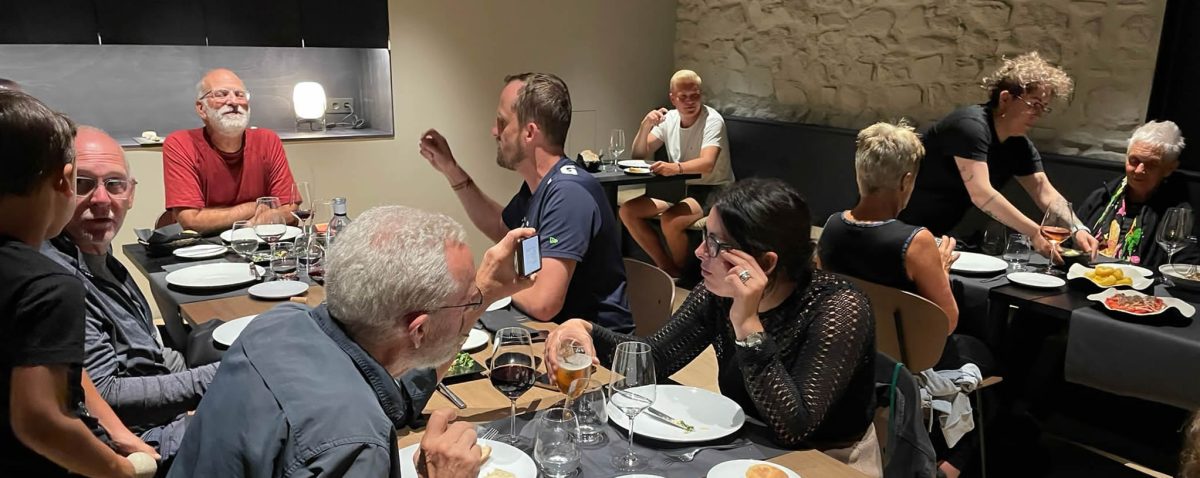
What it looks like, instead, is a person. A specific kind of person — one who has done the historical work, who knows the Zugarramurdi trials in enough detail to speak about them honestly, who has read Barandiaran and taken the mythological tradition seriously enough to understand what the Spirit was doing in it, who is learning Euskara not as a missionary strategy but as an act of love, who can sit in a txoko — the traditional Basque gastronomic society — for hours without an agenda, building the kind of friendship that the culture’s own social forms require before the deeper conversations become possible.
When the moment comes — and it comes, in the mountains, over food, in the silence after a conversation has gone somewhere that neither person expected — the introduction begins not with the Gospel presentation but with the honest naming of the wound. The prosecution of the sorginak was a theological crime. What was burned at Zugarramurdi was not the devil’s work. And the Jesus I follow would not have presided over those bonfires. He would have been on the other side of them.
That statement — made with genuine historical knowledge and genuine conviction, without institutional defensiveness, without rushing past it toward more comfortable ground — opens a door that has been nailed shut for four centuries. Behind it is a Jesus who is distinguishable from the institution. Not by assertion. By argument. By the historical and theological case that the cross of Calvary was the execution of an innocent person by the collaboration of institutional religion and imperial power — and that the God revealed in that cross is found with the condemned, not the condemning.
Sixth: The Goal the American Evangelical Church Needs to Hear
Here is where this post asks something of its American evangelical reader that may be uncomfortable.
The goal of mission in the Basque Country is not a Basque church that looks like an American evangelical church conducted in Euskara. It is not the reproduction of Western evangelical culture in a new location. It is not the numerical growth of a movement that reports back to American funders in categories American funders recognize.
The goal is the Word becoming flesh in this specific people — in their specific language, their specific cultural forms, their specific historical experience of wound and survival and stubborn sacred imagination. The Basque Gospel movement, when it fully emerges, will do theology in forms that American evangelicalism has not developed: in the bertsolaritza tradition — the ancient Basque art of improvised theological verse, performed publicly, accountable to the community’s judgment — in the grammatical imagination of a language whose structure opens native homes for Trinitarian and incarnational theology that Castellano and English do not offer, in the mountains and txokos and cuadrillas that are the natural social forms of Basque life.
It will be led not by outside practitioners, however faithfully formed, but by Basque-speaking theologians who have encountered the Jesus of the Gospels and begun to think about what that encounter means from the inside. The outside practitioner’s goal — from the beginning, not as a late-stage aspiration — is their own obsolescence. They are there to create the conditions in which the inside practitioner can emerge. When that person is ready, the work of the outside practitioner is complete. Their job was never to produce the Basque Gospel movement. It was to serve its emergence faithfully enough that the Spirit could produce it through the people it actually belongs to.
The Basque Country is not spiritually empty. It is spiritually wounded — by an institution that used Christ’s name against it for four centuries — and spiritually alive, in ways that most Western evangelical mission frameworks are not equipped to recognize or honor. The Spirit has been in these mountains, in this solidarity tradition, in this stubborn sacred imagination, through everything the institution did to extinguish it.
The Jesus who belongs in this place is not the Christ of the Inquisition. He is the Galilean peasant from occupied territory who stood with the condemned, confronted the institution, and was executed by the collaboration of religious and imperial power — and who rose from the dead, vindicating every wrong verdict that power had ever pronounced.
That Jesus has been on this people’s side all along. It is long past time to introduce him properly.
Zurekin egon da beti. He has been on your side all along.
Next read:
Pushback from American Evangelicals
Real tensions in the thesis that require honest engagement rather than deflection.
The full thesis is available in both English and Castellano. For churches, mission agencies, or individuals interested in engaging further — whether theologically, practically, or in terms of support for the work — correspondence is welcome.