
On why a serious account of Basque spirituality must begin before the missionaries arrived — and why that changes everything that comes after
There is a temptation, when beginning a series on Basque spirituality, to begin with Christianity. To start with the missionaries who crossed the Pyrenees, the churches that rose over sacred springs, the saints whose names replaced older names, the institutions that shaped — and in some cases broke — a people’s relationship with the sacred. That is, after all, where most accounts begin. It is where most accounts end, too.
This series begins somewhere else.
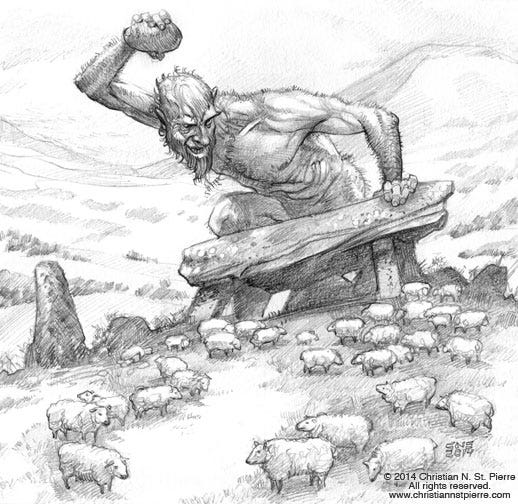
It begins before Rome. Before Calvin. Before the first priest climbed into the mountains and looked out over a landscape that had been, for longer than Christianity had existed, already alive with the sacred. It begins with what was already there — the gods and spirits who inhabited specific peaks and springs and forest edges, the ancestors who remained present across generations, the ancestral house as a living entity, the community organized around structures of belonging so deep they functioned as cosmology. It begins, in other words, with the Basque people themselves, on their own terms, before anyone arrived to correct or complete or convert them.
That beginning is not a rhetorical strategy. It is the only honest place to start.
WHY THIS SERIES, AND WHY NOW
The Basque are among the most studied and least understood peoples in Europe. Their language — Euskara, spoken by perhaps a million people, with no known relative anywhere on earth — has fascinated linguists for centuries. Their genetic distinctiveness has attracted anthropologists. Their history of resistance to Roman, Visigoth, Frankish, Napoleonic, and Francoist attempts at assimilation has made them a symbol of cultural endurance. Their cooperative economic experiments have drawn economists and social theorists from around the world.
Their spiritual life has received considerably less serious attention.
What attention it has received has tended to fall into one of two patterns. The first treats Basque folk religion as picturesque — a collection of charming mountain legends and harvest festivals, interesting as ethnography, now largely superseded by modernity. The second treats it as a problem — a set of pre-Christian beliefs that were either absorbed into Catholicism or persisted as superstition, either way representing an obstacle to full Christian formation rather than a tradition with its own integrity.
Both patterns miss the point.
What the Basque carried into their encounters with Christianity — and what they carry still, even in a largely secularized form — is not folklore or superstition. It is theology. A coherent, sophisticated engagement with the fundamental questions of human existence: how does the sacred inhabit specific places? How do the living maintain relationship with the dead? What structures hold a community together across generations? What does the land owe its people, and what do its people owe the land?
These are serious questions. They deserve serious treatment. This series attempts to provide it.
WHAT THIS SERIES IS NOT
It is not a missionary manual. There are other places in this body of work that address the practical questions of cross-cultural Christian witness among the Basque. This series precedes and undergirds that work, but it is not primarily directed at people asking “how do we evangelize the Basque.” It is directed at anyone — Christian, Basque, neither, both — who wants to understand what the sacred has looked like in this particular corner of the world, honestly and in full.
It is not a romanticization. The Basque spiritual inheritance is not presented here as a lost golden age, a pristine tradition uncorrupted by history, or a noble alternative to Western religion. Every tradition has its shadows, its coercions, its unanswered questions. The Basque tradition is no exception. But the shadows do not negate the substance, and the substance deserves to be seen clearly before the shadows are catalogued.
It is not a covert argument for any particular theological conclusion. The series will engage Christian theology directly — it would be dishonest to pretend that the author has no convictions about the relationship between Basque spiritual wisdom and the claims of Christ. But that engagement is a conversation, not a verdict. Readers who arrive skeptical of Christianity will find, in these posts, a genuine attempt to honor what the Basque knew before the missionaries arrived. Readers who arrive as committed Christians will find, alongside that honoring, the kind of theological reckoning that Christian mission in this region has too often avoided.
THREE MOVEMENTS
The series is organized into three movements, each addressing a different layer of the subject.
The first movement — The Tradition Itself — takes Basque pre-Christian spirituality seriously on its own terms. These posts do not ask what Christianity made of Basque spiritual life. They ask what Basque spiritual life actually was and is: the mythological world of Mari, the Basajaun, and the laminak; the ancestral house as a living cosmological center; the theology of death and the presence of the departed; the sacred status of the Basque language itself. These posts are the foundation on which everything else rests.
The second movement — The Wounds and the Witnesses — turns to history. Not to rehearse grievances, but because honest engagement with the present requires honest reckoning with the past. These posts examine what the Inquisition and the Franco regime specifically did in the Basque Country, how the Church’s complicity with Francoist suppression created the wound that still determines who will and will not engage with institutional Christianity today, and what the diaspora experience reveals about which dimensions of Basque spiritual life are portable and which are rooted in the soil itself.
The third movement — Toward Honest Encounter — attempts the constructive work. What would genuine theological dialogue between Christian tradition and Basque spiritual wisdom actually look like, as distinct from the absorption of one into the other? What does a Basque reading of Ignatius of Loyola reveal that an ecclesiastical reading misses? What theology is embedded in the Mondragon cooperative? And what does the “groundless generation” of young Basques — formed without the religious structures their parents lost — actually need, and from whom?
A WORD ABOUT THE AUTHOR’S POSITION
A series like this one requires some transparency about where the author stands, because the position one occupies shapes what one is able to see.
I write as someone formed by evangelical Christianity, which means I carry assumptions about how the sacred works, what faith requires, and what mission means that I have had to examine — and in some cases revise — in the course of this project. I do not claim to have fully transcended those assumptions. I claim only to have tried to hold them loosely enough that they do not prevent me from seeing what is actually in front of me.
I write as someone who has spent significant time with Basque people, in Basque places, listening more than speaking. What I have heard has repeatedly exceeded what I expected to hear, and repeatedly exceeded what my prior frameworks were equipped to honor. The series is, in part, an attempt to build frameworks adequate to what I have encountered.
I write with deep respect for the people whose spiritual inheritance is the subject of these posts — and with awareness that respect, however genuine, is not the same as understanding, and understanding is not the same as belonging. I do not belong to this tradition. I am a witness to it, at best a sympathetic student. These posts should be read accordingly.
AN INVITATION
The sacred was already here before the first missionary arrived. The mountains were already speaking. The dead were already present. The community was already organized around structures of belonging that functioned, whether or not anyone used the word, as theology.
That claim is the premise of everything that follows. It is not an argument against Christianity. It is not a concession to relativism. It is simply what honesty requires when you look at this people and this place with clear eyes.
If it unsettles you — if you arrived expecting a series that positions Christian mission as the beginning of Basque spiritual history — then this series is probably more useful to you than one that would confirm what you already believed. That unsettlement is not a problem to be resolved before you continue reading. It is the beginning of the only kind of understanding worth having.
The Basque have been keeping the sacred alive in these mountains for longer than any of us can fully reckon with. The least we can do is pay attention.